What an SBOM Tells You, and What It Does Not

A supplier sends you an SBOM, or your own pipeline starts producing one, and someone asks the natural question: so are we safe? The file cannot answer that. It was never designed to, and reading it as if it could turns a useful document into a flood of alerts nobody trusts.
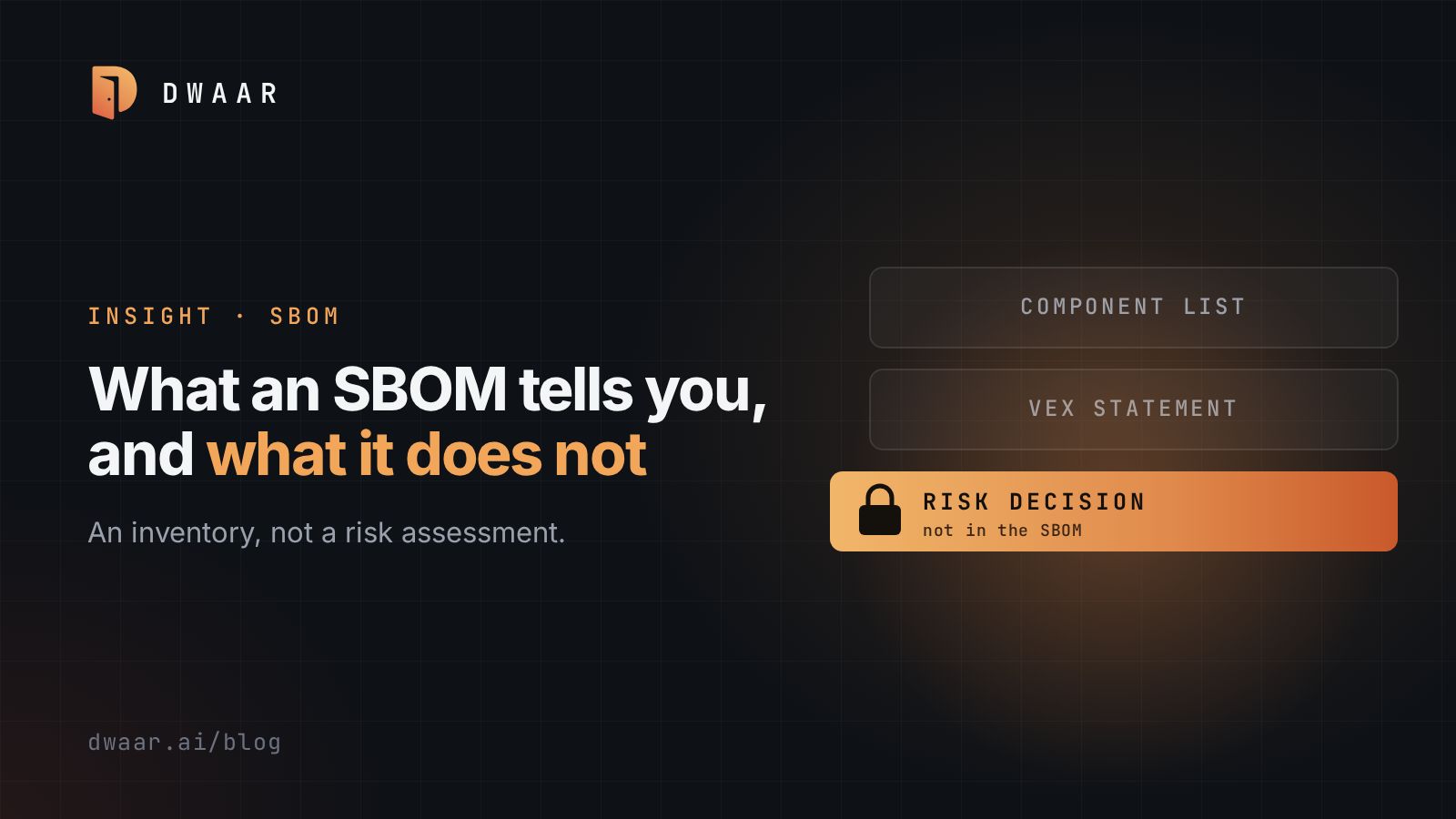
An SBOM is an ingredient list. Ask for it, automate it and keep it, because the rest of the work depends on it. Do not mistake it for a risk assessment.
What the document claims to be
NTIA's 2021 report defines an SBOM as "a formal record containing the details and supply chain relationships of various components used in building software." Its baseline fields are supplier name, component name, version, other unique identifiers, dependency relationship, author of the SBOM data, and timestamp. Nothing in that list describes severity, exploitability or whether a line of code ever runs.
CISA's August 2025 draft is direct about the limit: an SBOM "will not resolve all software security and supply chain concerns, but it is a necessary step." That document calls itself "a pre-decisional draft for public comment", so the 2021 report remains the last final baseline.
The obvious approach, and why it fails
The obvious move is to feed the SBOM to a vulnerability scanner and treat each match as a finding. The file has names and versions, the databases have names and versions, so it looks correct.
A study of SBOMs across 2,414 open source repositories shows the cost, although that large dataset is not where its false positive figure comes from. For that, the authors moved to checking scanner output by hand on a small sample: of 113 reported vulnerabilities, they confirmed 9. They call this "a staggering 92.0% false positive rate" in their case study, mainly vulnerabilities in unreachable code. The paper's results table lists 16 repositories, each with fewer than 20 reported vulnerabilities, although one sentence in its text says four. Function call analysis cut the 113 alerts to 42, and the table still puts the false positive rate of those at 78.6%.
The same paper finds that lock files with strong package managers produce accurate and consistent SBOMs. The list was fine. The inference drawn from it was wrong. That is one small case study, not a constant, but the mechanism holds: a component being present says nothing about whether the vulnerable function gets called.
Presence does not tell you intent either. CISA reported malicious code in XZ Utils 5.6.0 and 5.6.1 and advised downgrading to 5.4.6. The inference here is mine, not CISA's: an SBOM could tell you those versions were present once someone had named them, but a backdoored version looks like any other row. That is why vulnerable and malicious packages are different problems.
Is the list even right?
Accuracy depends on how and when the SBOM was made. CISA's guide to SBOM types says "tool outputs may vary", and that analyzing artifacts after the build "generally requires a variety of heuristics." Research on Python generators found tools "often suffer from inaccuracies in identifying components and dependencies." That work covers one ecosystem in 2024, so do not stretch it.
NTIA's minimum asks only that "all top-level dependencies must be listed with enough detail to seek out the transitive dependencies recursively." It requires authors to declare known unknowns, and says "the default interpretation of the data should be that the data is incomplete."
The sources do not fully agree. The 2025 draft says "recipients can expect SBOM data to be accurate", and that a recipient "should be able to conclude that a newly reported vulnerability does not affect them if the component associated with the vulnerability is not listed." The same document suggests they "confirm the accuracy, coverage, and completeness of SBOM data" using sources such as open source repositories or binary analysis tools.
I side with the verification. A missing row is only evidence if coverage is real, and you cannot judge coverage without knowing how the file was produced. That is why the draft's new Tool Name and Generation Context fields (before, during or after build) matter. Ask for them now, draft or not.
The Cyber Safety Review Board's Log4j review found that having "no comprehensive 'customer list' for Log4j" hindered defenders, and of the SBOM users it spoke to, "none reported having leveraged them to identify vulnerable deployments of Log4j." That was 2022, and CISA's draft says data quality has improved since. The lesson I keep is narrower: an inventory has to exist and be queryable before the day you need it.
VEX answers a different question
NTIA described the core of VEX in 2021 as communicating whether a given piece of software is "affected" by a given vulnerability. CISA's minimum requirements define four statuses: not_affected, affected, fixed and under_investigation. A not_affected statement needs an impact statement or a justification, and the justifications name what an SBOM cannot express, such as vulnerable_code_not_in_execute_path and vulnerable_code_cannot_be_controlled_by_adversary.
VEX has limits of its own. It is a claim, and CISA notes it "can be authored by the supplier of the software or by a third party", so record who is making it. OWASP points out that VEX "cannot describe vulnerabilities that do not already have an identifier."
Put together, the questions divide up like this.
| Question | Can the SBOM answer it? | What you need alongside it |
|---|---|---|
| What components and versions are in this release? | Yes, within its coverage | Generation Context and Tool Name |
| Is the component from a new CVE present at all? | Yes, if the list is complete | Independent verification, such as binary analysis |
| Is this product affected by this CVE? | No | A VEX statement or your own analysis |
| Can the vulnerable code be reached? | No | Function call analysis |
| Is anyone exploiting it? | No | KEV and EPSS signals |
| Is this package malicious? | No | A separate check, and an advisory once one exists |
Where this position stops applying
For inventory and license questions, the SBOM largely is the answer. When a complete SBOM has no row for the affected component, you can rule out a CVE quickly. If you generate from lock files with a strong package manager, the study above suggests generator accuracy should worry you less and your effort moves downstream.
My recommendation for daily use: generate one per release, at build time or from the artifact you ship, and record the tool and phase. Store it where you can query it by component. Use it as the lookup key into advisories, KEV and EPSS, and attach VEX where a supplier provides it. Rank on those signals, never on the count of matches.
That is why Dwaar discovers what you ship from source control, registries and cloud accounts, scans it, and keeps one findings list alongside EPSS and KEV signals.
Try this on one release
Pick one service you shipped recently and produce two SBOMs for it: one from the build, and one from the artifact that actually went out. Compare component names and versions, and look at every row that appears in only one of them. Each difference is either a naming disagreement or a component one method cannot see. Until you know which, a missing row does not rule out a CVE.
References
- NTIA, The Minimum Elements For a Software Bill of Materials (SBOM), July 12, 2021
- Cyber Safety Review Board, Review of the December 2021 Log4j Event, July 11, 2022
- OWASP, VDR and VEX comparison, February 7, 2023
- CISA, Minimum Requirements for VEX, April 2023
- CISA, Types of SBOM Documents, April 21, 2023
- CISA, Reported Supply Chain Compromise Affecting XZ Utils, CVE-2024-3094, March 29, 2024
- Benedetti et al., arXiv, The Impact of SBOM Generators on Vulnerability Assessment in Python, September 10, 2024
- CISA, 2025 Minimum Elements for an SBOM, Public Comment Draft, August 2025
- Zhou, Dacier and Konstantinou, arXiv, A Reality Check on SBOM-based Vulnerability Management, November 25, 2025, revised April 17, 2026