CVSS Is Not Risk: How to Use EPSS and KEV

Your scanner sorted the findings by CVSS, and the top of the queue is a wall of 9.8s. You can patch some of them this week, and the score cannot tell you which. It was never built to.
The obvious sort, and why it fails
Sorting by CVSS and working down feels defensible because the number comes from a standard. The standard tells you not to. The CVSS v4.0 User Guide says Base scores "are designed to measure the severity of a vulnerability and should not be used alone to assess risk," and that the Base Score is "independent of any factor associated with threat or the computing environment."
The earlier v3.1 specification adds the reasoning. It describes a vulnerability's intrinsic characteristics as "constant over time," and says the score assumes the reasonable worst case impact across deployed environments. So a Base score does not move when exploitation starts, and it does not know whether the affected host is exposed. It describes the flaw, not your situation.
That matters because, per NIST CSWP 41, "only a small fraction" of the vulnerabilities published each year will be exploited. The EPSS authors say severity-based strategies "are poor predictors of actual vulnerability exploitation because they do not incorporate new information."
CVSS still has a job. It is the only one of the three signals here that describes impact, and v4.0 labels each score by what went into it: CVSS-B, CVSS-BT, CVSS-BE or CVSS-BTE. The mistake is asking a Base score to answer "what goes first?"
One record, one forecast
KEV is a record. CISA's catalog was established by BOD 22-01 on November 3, 2021, and it holds 1,540 entries as of this week, per the March 11 release of CISA's feed. Its criteria are an assigned CVE ID, reliable evidence of active exploitation in the wild, and a clear remediation action. A public proof of concept is not required.
The directive gives federal civilian agencies default deadlines of two weeks, or six months for CVE IDs assigned before 2021, adjustable for grave risk. Ivanti's CVE-2025-0282 was added on January 8, 2025 and due a week later. The directive probably does not bind you, but those dates are a useful benchmark.
EPSS is a forecast. FIRST's FAQ describes a probability between 0 and 1 of exploitation activity in the next 30 days, refreshed every day for each published CVE. The 2023 paper reports an 82% performance improvement over past EPSS models at distinguishing exploited vulnerabilities. That is the authors' own number, and it says nothing about how often a given score is right.
FIRST calls EPSS "a measure of exploitability," meaning the chance of exploitation attempts. CISA uses exploitability to mean how easily an attacker can take advantage of a flaw, and says it "is not considered as criteria for inclusion in the KEV catalog."
| Signal | Question it answers | When it changes | What it cannot tell you |
|---|---|---|---|
| CVSS Base | How severe is this flaw, by its nature? | Constant over time | Whether anyone is exploiting it, or your exposure |
| KEV | Is there reliable evidence of exploitation, and a clear fix? | When CISA adds an entry | Anything about the exploited vulnerabilities it does not list |
| EPSS | How likely is exploitation activity in the next 30 days? | Every day | Impact, your environment, your compensating controls |
The order I would use
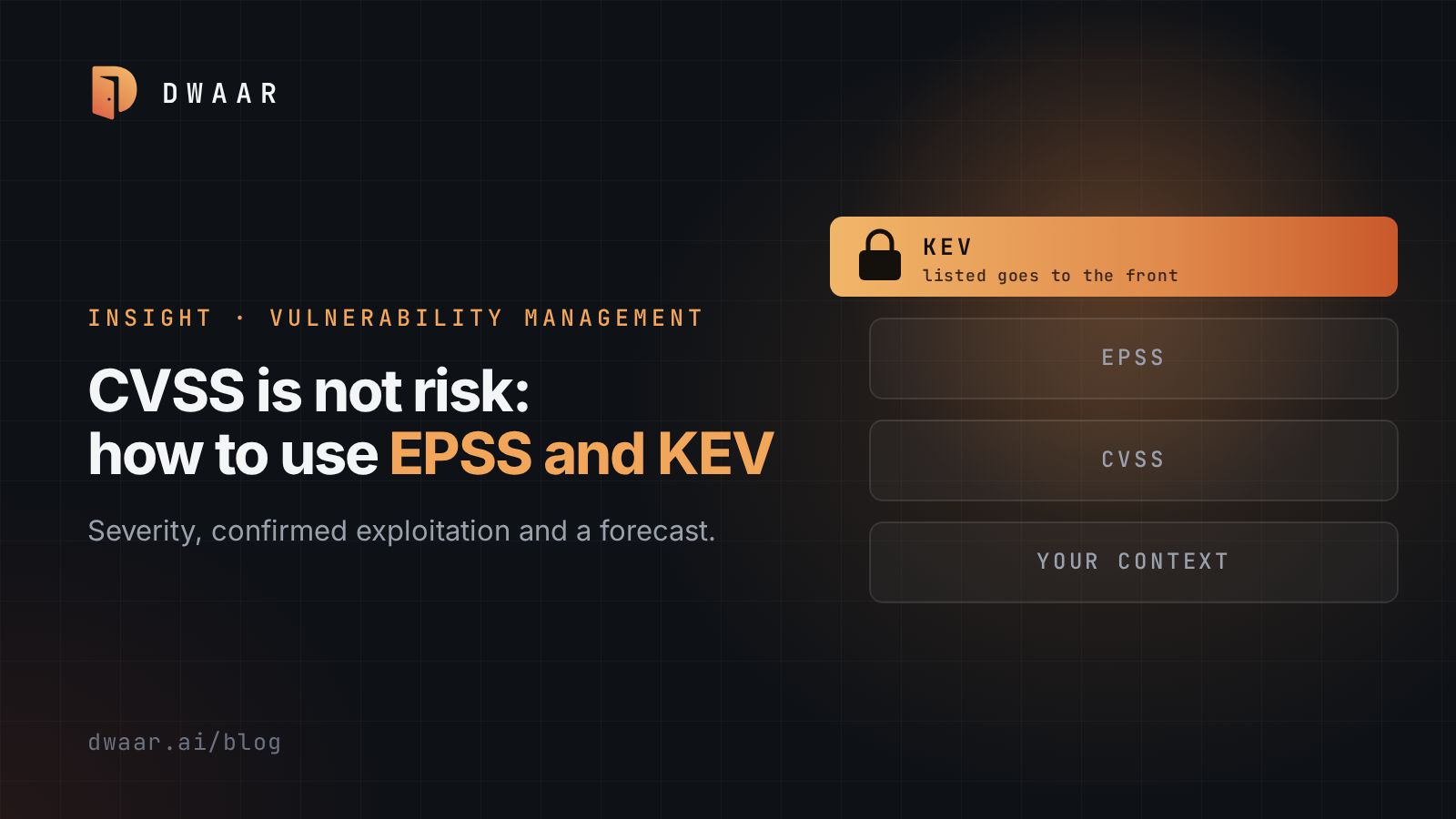
Start with KEV. If a finding is listed, it goes to the front, whatever its other scores say. FIRST says the same about its own score: "If there is evidence that a vulnerability is being exploited, then that information should supersede anything EPSS has to say." A low EPSS score on a KEV entry is not a contradiction, because a forecast and a record are different things.
Rank everything else by EPSS, which FIRST says "works best just below the obvious." Do not borrow a cutoff. A threshold is a capacity decision, so set it where your team runs out of patching capacity.
Use CVSS as the tiebreak. EPSS makes no attempt to estimate impact, so between two findings with similar probabilities, the more severe one goes first. Use CVSS-BT or CVSS-BTE with your own environmental metrics if you have them.
Then apply what only you know: is it reachable, is the asset internet-facing, what does it hold? Verizon's 2025 DBIR says edge devices and VPNs were the target in 22% of its vulnerability exploitation actions, up almost eight-fold from 3% in the previous report, so an internet-facing VPN appliance and a build-only dependency should not share a rank even with identical scores. My rule is that context can move a finding down only with a written reason. "The affected component is not deployed" qualifies. "This feels low risk" does not.
Where this stops
None of the three is a risk score. FIRST says EPSS "is not, and should not be treated as a complete picture of risk." It takes no account of your environment or compensating controls, and neither do KEV or CVSS Base.
NIST CSWP 41 says EPSS "has known inaccurate values" and KEV lists "may not be comprehensive." CISA's FAQ explains one reason: reliable evidence of exploitation is "only one of the criteria," so an exploited flaw with no CVE ID or no clear remediation will not appear. BOD 22-01 scopes the catalog to vulnerabilities that "carry significant risk to the federal enterprise," and CISA itself does "not recommend exclusive use of the KEV Catalog as the only criterion" for triage. Absence from KEV tells you nothing about safety.
Ranking also does nothing for speed. Mandiant reports that average time to exploit fell to five days in 2023, from 63 days in 2018-19. Of 138 exploited vulnerabilities it analyzed for 2023, 97 were zero-days, exploited before a patch existed, which no queue handles. A perfect order still loses if your patch path takes a month. A queue is one part of a program, and scanning alone is not a security program.
If you have few enough findings to fix them all, skip the ordering. If an audit commitment is written against CVSS thresholds, keep meeting it and use this order inside those bands.
Try it on your last scan
Export your latest findings and take the top 20 by CVSS. Then match every CVE ID in the full export against CISA's KEV feed and add EPSS scores from the daily CSV that FIRST's FAQ points to.
Now count how many KEV entries sat below your top 20, and how many of your top 20 are neither in KEV nor near the top by EPSS. The first number is exploited work you were scheduling late. The second is effort you can move. Then write one line for each KEV entry saying whether the affected component is deployed and reachable.
References
- FIRST, CVSS v4.0 User Guide, v1.2, November 14, 2025 (first published November 1, 2023)
- FIRST, CVSS v3.1 Specification Document, Revision 1, undated, archived March 8, 2026
- FIRST, EPSS Frequently Asked Questions, undated, archived March 8, 2026
- Jacobs et al., arXiv, Enhancing Vulnerability Prioritization: Data-Driven Exploit Predictions with Community-Driven Insights, June 15, 2023
- CISA, BOD 22-01: Reducing the Significant Risk of Known Exploited Vulnerabilities, November 3, 2021, archived March 11, 2026
- CISA, Reducing the Significant Risk of Known Exploited Vulnerabilities, undated, archived March 9, 2026
- CISA, Known Exploited Vulnerabilities catalog JSON feed, catalog version 2026.03.11, archived March 11, 2026
- NIST, CSWP 41: Likely Exploited Vulnerabilities, May 19, 2025
- Google Cloud / Mandiant, How Low Can You Go? An Analysis of 2023 Time-to-Exploit Trends, October 16, 2024
- Verizon, 2025 Data Breach Investigations Report: Executive Summary, April 2025