Why Scanning Alone Is Not a Security Program

Your scanner finished overnight and the report is long. Somebody now has to say which findings get fixed this week, who does the work, and how anyone will know the fix held. The scanner cannot answer those questions, and running it more often will not change that.
A scanner produces a list. A security program produces a decision. Scanning is necessary, and a small team should start there, but the list is where the work begins.
The obvious approach, and why it stalls
The obvious approach is to scan everything, sort by severity and work from the top. It runs into capacity first. Verizon's 2025 DBIR reports that organizations fully remediated only 9% of all vulnerabilities identified in their scans. That rate cannot say how much of the remainder was a deliberate choice and how much nobody read, and neither can the list.
Then it runs into signal. CISA set up the KEV catalog in BOD 22-01 in 2021, and the directive's FAQ says that, based on "a study of historical vulnerability data dating back to 2019, less than 4% of all known vulnerabilities have been used by attackers in the wild" and that the CVSS "base score does not account for if the vulnerability is actually being used to attack systems." Sorting by severity answers a different question from the one you have.
Then the clock. The same DBIR found exploitation of vulnerabilities in 20% of breaches, up 34% on the prior year. Using addition to KEV as its proxy for mass exploitation, a definition it made "a bit more generous" to get an upper bound, it measured a median of five days from CVE publication for KEV entries from 2022 onward (n=292), and zero days for its edge device subset, where 9 of 17 were listed on or before publication day. That subset is small, so read the zero as indicative. Only about 54% of those edge vulnerabilities were fully remediated, at a median of 32 days. Finding faster does not close a gap that wide.
A clean scan is not an answer
The Equifax breach is nearly nine years old, and a congressional committee's staff wrote down the details. Per the majority staff report, the Apache Struts flaw CVE-2017-5638 was disclosed on March 7, 2017. On March 9 the notice, with a 48-hour patching deadline, was emailed to approximately 430 individuals and distribution lists. Scans on March 15 "did not detect the vulnerability on any externally facing systems." Attackers entered through the ACIS portal on May 13. The device monitoring traffic leaving that application "had been inactive for 19 months due to an expired security certificate."
That is an account of one company's scans with its two tools, and it does not show that every scanner would have missed the flaw. My claim is narrower: a clean result was not the same as being safe, and you can only challenge one if you have something to check it against. The report found that IT and Security kept "multiple and incomplete software inventory lists." An email to 430 recipients is a broadcast, not an assignment, and the vulnerable software stayed unpatched.
What sits between the list and the decision
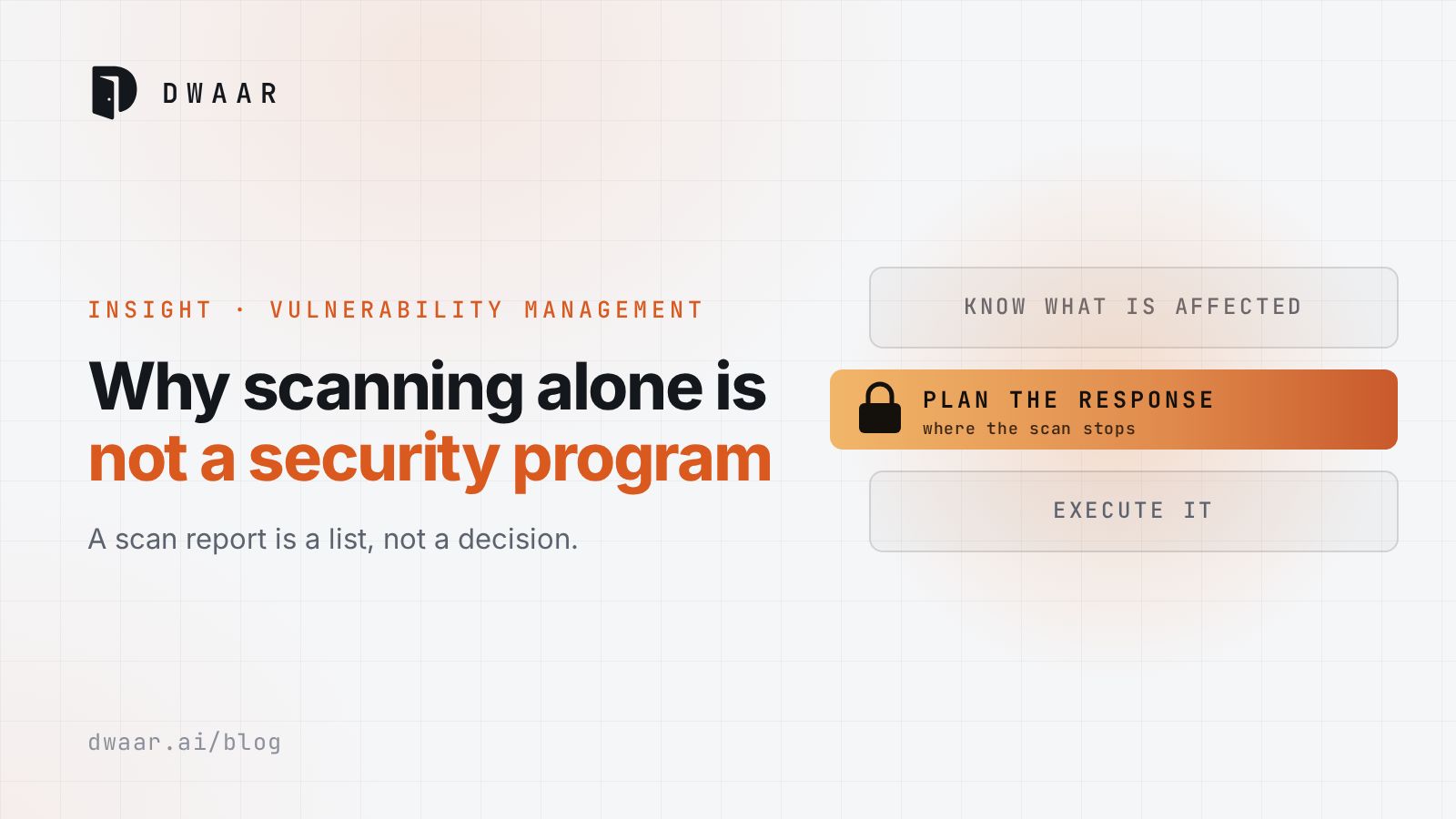
NIST SP 800-40 Rev. 4 describes a life cycle of three steps: know when new vulnerabilities affect your assets, plan the risk response, then execute it. Scanning helps with the first. The rest of the gap, as I see it:
| Question | What the scan gives you | What the program adds |
|---|---|---|
| What do we run? | Whatever it looked at, when it looked | An inventory kept current, down to packages and libraries |
| Who acts? | Nothing | A maintenance group with a plan, and a named team |
| Does this one matter here? | A component match and a severity | Exploitation evidence, exposure, a recorded reachability call |
| What do we do? | A finding | One of four responses: accept, mitigate, transfer, avoid |
| Did it work? | A later scan that stops flagging | Verification now, monitoring afterward |
Inventory comes first. NIST's first step means knowing "which software and software versions those assets run down to the level of packages and libraries." It also says that refreshing inventories monthly or quarterly with a vulnerability scan, once "generally considered acceptable," no longer is.
Ownership is next. NIST asks for maintenance groups, sets of assets with similar maintenance needs, and is blunt about the awkward cases: "Instead of denoting certain assets or types of assets as “exceptions,” there should be maintenance groups for them." I would go further and put a team's name on every group, because a group with no name attached is a distribution list.
Reachability is where scanner noise is real and where teams overcorrect. A study of 200 popular open source Java libraries used by SAP found "about 20%" of vulnerable dependencies were not deployed. That is one data point from 2018, Java only, from one company's corpus. But CISA's VEX guidance warns: "A single path of execution should not be assumed since the attacker may be able to divert the path of execution." So treat "not reachable" as a recorded assertion someone can review, never a silent suppression.
The EPSS paper describes its scores as true probabilities, the "probability of any exploitation activity being observed in the next 30 days." That is a forecast and not a verdict. KEV records exploitation CISA has evidence of, and given the edge numbers above, waiting for a listing on an internet-facing device is not a plan.
Fixing is wider than patching. In NIST's words, "Patching is one of several ways to respond to risks from software vulnerabilities." The appliance you cannot patch still gets an answer: disable a feature, decommission it, or accept the risk on the record.
Proof comes last. NIST separates verifying that a patch installed and took effect from monitoring that it was not later uninstalled, restored from backup, or reset to a vulnerable factory default. A later clean scan is evidence about the first, only as far as the scan can see. Equifax's monitoring device is the warning on the second: a control that has quietly died looks exactly like a control with nothing to report.
Where this stops applying
If you have a handful of repositories and nobody on security full time, scanning first is the right call, and the question is what to add next. And do not spend an afternoon arguing a finding is unreachable when updating is cheap.
What this blog is for
This is the first post here. We will write about vulnerabilities, public incidents and the decisions they force, with primary sources and honesty about thin evidence. This gap is also what Dwaar works on: discovering what you ship from source control, registries and cloud accounts, scanning it, and keeping the results in one findings list with EPSS and KEV signals.
Try this on your own report
Take your last scan report and the five findings at the top. For each, write one line: where it runs and at what version, which team owns it, whether it is on KEV and its EPSS score, whether it is reachable and who says so, which of the four responses you chose, and how you would know the fix took effect and stayed. Then count the blanks. Those blanks are your program's real backlog, and no rescan will fill them.
References
- 2025 Data Breach Investigations Report, Verizon, released April 23, 2025
- SP 800-40 Rev. 4, Guide to Enterprise Patch Management Planning, NIST, April 2022
- BOD 22-01: Reducing the Significant Risk of Known Exploited Vulnerabilities, CISA, November 3, 2021
- Vulnerability Exploitability eXchange (VEX), Status Justifications, CISA, June 2022
- Enhancing Vulnerability Prioritization: Data-Driven Exploit Predictions with Community-Driven Insights, Jacobs et al., arXiv, last revised June 15, 2023
- The Equifax Data Breach, Majority Staff Report, U.S. House Committee on Oversight and Government Reform, December 2018
- Vulnerable Open Source Dependencies: Counting Those That Matter, Pashchenko et al., ESEM 2018 via arXiv, August 29, 2018