Cordyceps: Exploitable GitHub Actions Workflows in Over 300 Repositories

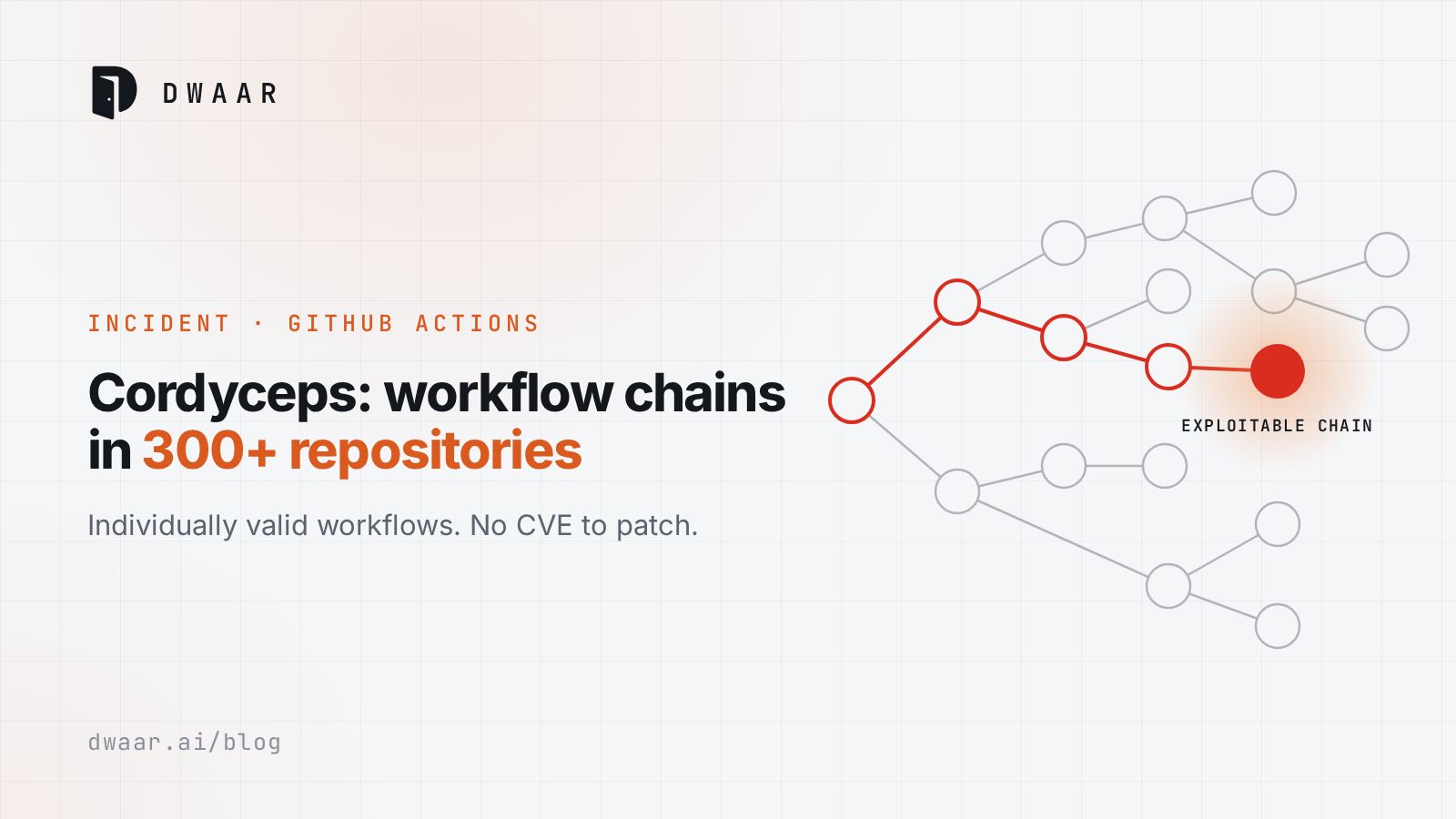
Your pull request workflow passed review. So did your release workflow. Neither file contains a bug you could point at in a diff, and a stranger with a free GitHub account may still be able to walk from one to the other. That is the claim in research published on 2026-06-23, which names this class of weakness Cordyceps. There is nothing to upgrade. The fix lives in your own workflow files.
| Item | Detail |
|---|---|
| Identifier | No CVE or advisory id in the coverage. Cordyceps is the finders' name for the class |
| Affected | More than 300 repositories confirmed exploitable and 654 flagged, from about 30,000 high-impact repositories |
| Fixed in | No versions. Fixes are workflow changes in each repository, with no commit hashes in the sources |
| Severity | No CVSS score from the finders, and none from an affected vendor in the coverage. "Critical" is the finders' own word, not an official rating |
| Exploited as of 2026-06-25 | None reported in the sources available today. Researcher Elad Meged told Dark Reading there is "no evidence that any attacker or group has applied the pattern broadly, at scale". The researchers demonstrated exploitability. With no CVE, there is nothing for CISA KEV to list |
| Disclosed | 2026-06-23 by the finders, with press coverage that day and on 2026-06-24 |
Use the measured numbers. SecurityWeek's headline says millions of repositories are exposed, and that traces back to the finders' statement that AI coding agents let the same mistakes "compound across millions of repositories". Nobody counted those. The 654 and the 300 are the findings, and the coverage gives no breakdown by class, so neither number is a count of cross-workflow chains.
The bug is the edge between two files
SecurityWeek reports flaw types ranging from command injection to authentication logic, artifact poisoning and privilege escalation:
- Command injection. Attacker-controlled text reaches a shell. The reported Cloudflare case used a crafted branch name, and GitHub's reference documents the same risk for a pull request title expanded in an inline script.
- Authentication logic. The coverage names this type without describing a mechanism. The reported outcomes include forged approvals.
- Artifact poisoning. GitHub warns that workflows triggered on
workflow_runshould treat artifacts uploaded from other workflows with caution. - Privilege escalation across workflows. A low-privilege workflow passes its output along until it reaches a high-privilege workflow.
The last one is where the file-by-file view fails. The privileged workflow authenticates to cloud providers, holds signing keys and publishes releases. The low-privilege one can be triggered by an untrusted pull request or comment. Read alone, each is valid. The Hacker News carries the line that sums it up: "The workflow does what it was told. The vulnerability exists only in the composition."
The sources give no exact triggers or workflow files per repository, so I can't walk you through one of these chains line by line. The per-repository detail below is the finders' own account of their own research, as relayed by the press, so read it with that in mind.
What the named cases show
- Microsoft Azure Sentinel. A pull request comment could run attacker code on Microsoft's CI and steal a non-expiring GitHub App key. The Hacker News reports that Microsoft and Google confirmed impact.
- Google adk-samples. The Hacker News says a pull request could run attacker code on Google's CI and gain complete authority over a Google Cloud repository. Dark Reading quotes more specific wording: "authenticated control over the associated Google Cloud project".
- Apache Doris. The Hacker News describes two zero-click attacks, where a single comment on any pull request or a forked pull request runs attacker code and exfiltrates hard-coded CI credentials or a token with full write permissions. Dark Reading reports that Apache applied fixes.
- Cloudflare Workers SDK. A crafted branch name could execute arbitrary commands on CI runners. Dark Reading reports that Cloudflare applied hardening.
- PSF Black. A single pull request from anyone could run code on build systems and steal an automation token able to approve pull requests. The Hacker News lists Python with Cloudflare and Apache as having applied hardening and patches, without specifics.
SecurityWeek lists the possible outcomes: malicious packages on npm, PyPI, crates.io, GHCR and Helm, pushes to protected branches, AWS, GCP and Netlify credential theft, compromised self-hosted runners, bot impersonation and forged approvals. The entry requirement is a free account, with no organization membership.
What to check and do now
There are no versions to move to, and the sources publish no indicators, log signatures or queries, so this is an audit and not a hunt.
- List every workflow a stranger can start. Fork pull requests, comments, and anything downstream of them. GitHub's secure use reference says to avoid
pull_request_targetandworkflow_runwith untrusted pull requests or code content, because they can be exploited to take over a repository. The Cordyceps coverage does not tie them to specific cases. - List every workflow holding something worth stealing. Cloud authentication, signing keys, publish rights, write tokens.
- Draw the edges. For each workflow in step 2, write down every artifact and output it consumes from another workflow. If the producer is in step 1, that value is attacker input, however internal it looks.
- Remove inline expressions. Any branch name, title or comment body expanded directly inside a
runor script step goes through an intermediate environment variable instead. - Make authorization fail closed. Authentication logic is one of the reported flaw types, so test that any check in a comment-triggered workflow really denies an outsider.
- Reduce what a win yields. Set
GITHUB_TOKENto read-only by default and elevate per job, and pin third-party actions to a full commit SHA, as GitHub advises. Neither breaks a chain. Both limit what it reaches. - Replace long-lived credentials behind any path you found. With no published indicators, you can't prove a clean history. Treat the credential as exposed.
For step 4, GitHub's example begins like this, excerpted up to where its script starts:
      - name: Check PR title
        env:
          TITLE: ${{ github.event.pull_request.title }}
        run: |
Review the graph, not the file
SecurityWeek's summary names the habit behind this: workflow files get treated as configuration and not as security-critical code. I'd go further. Reviewing them as code one file at a time still approves every file in these chains. The finders say the issue "hides from scanners because, technically, every individual piece is working as designed", so a clean scan of your workflows says little about the paths between them.
My position: any change to a workflow's trigger, inputs or permissions has to answer "what consumes this, and who can start the thing that produces it?" The finders add that AI coding agents reproduce the same insecure patterns over and over. Your CI Pipeline Is Production made the general case last week, and the separate TanStack npm compromise shows where a CI chain can end when someone walks it for real.
Pick the most privileged workflow you own, the one that publishes or holds cloud credentials. Trace every input backward until you reach either a trusted person or a stranger with a free account.
References
- 'Cordyceps': Mushrooming Malicious Pull Requests Threaten Developer Workflows, Dark Reading, 2026-06-23
- Cordyceps CI/CD flaws expose 300+ GitHub repositories, The Hacker News, 2026-06-24
- Exploitable CI/CD Vulnerabilities Expose Millions of Repositories to Hijacking, SecurityWeek, 2026-06-24
- Secure use reference, GitHub Docs, undated living document