Do You Know Which AI Agents You Run?

Suppose a vendor tells you tomorrow that a tool connected to your AI agents was compromised and that you should treat its tokens as stolen. Which agents use that tool? Which tokens do they hold, and who can revoke them tonight? If answering takes a week of chat messages, you do not have an agent inventory, whatever your AI policy says.
The register everyone starts with
The obvious approach is a register: an intake form, a spreadsheet of approved AI tools. The NIST AI RMF Playbook backs the instinct. GOVERN 1.6 reads "Mechanisms are in place to inventory AI systems and are resourced according to organizational risk priorities", and the suggested actions include naming "a specific individual or team" to maintain the result.
Keep the owner. Drop the idea that a form gets you there, because a register fails in two ways.
First, it only knows what somebody told it. Agents get started on laptops through local MCP servers and switched on through SaaS settings, and neither path has to cross a form. I made the general case that a list kept by hand is always wrong in April. Agents are a harder version, because starting one does not feel like deploying a system.
IBM calls the wider pattern shadow AI. Its 2025 Cost of a Data Breach report, conducted by Ponemon Institute and based on breaches at 600 organizations, says 63% of breached organizations either had no AI governance policy or were still developing one, and that organizations with high levels of shadow AI saw an average of USD 670,000 in higher breach costs than those with a low level or none. IBM's own blog post on the report words the 63% more bluntly, as having no policies in place, so I am using the press release's definition. That is one study of breached organizations, sponsored and analyzed by a vendor with a commercial interest in the topic, and it measures governance. I have no study showing how many companies lack an agent list, so my claim is reasoning, not a statistic.
Second, a row saying "support agent, owned by the platform team" cannot answer the questions above. An agent acts through what it is connected to, and those connections change while its name stays the same.
An agent is a bundle
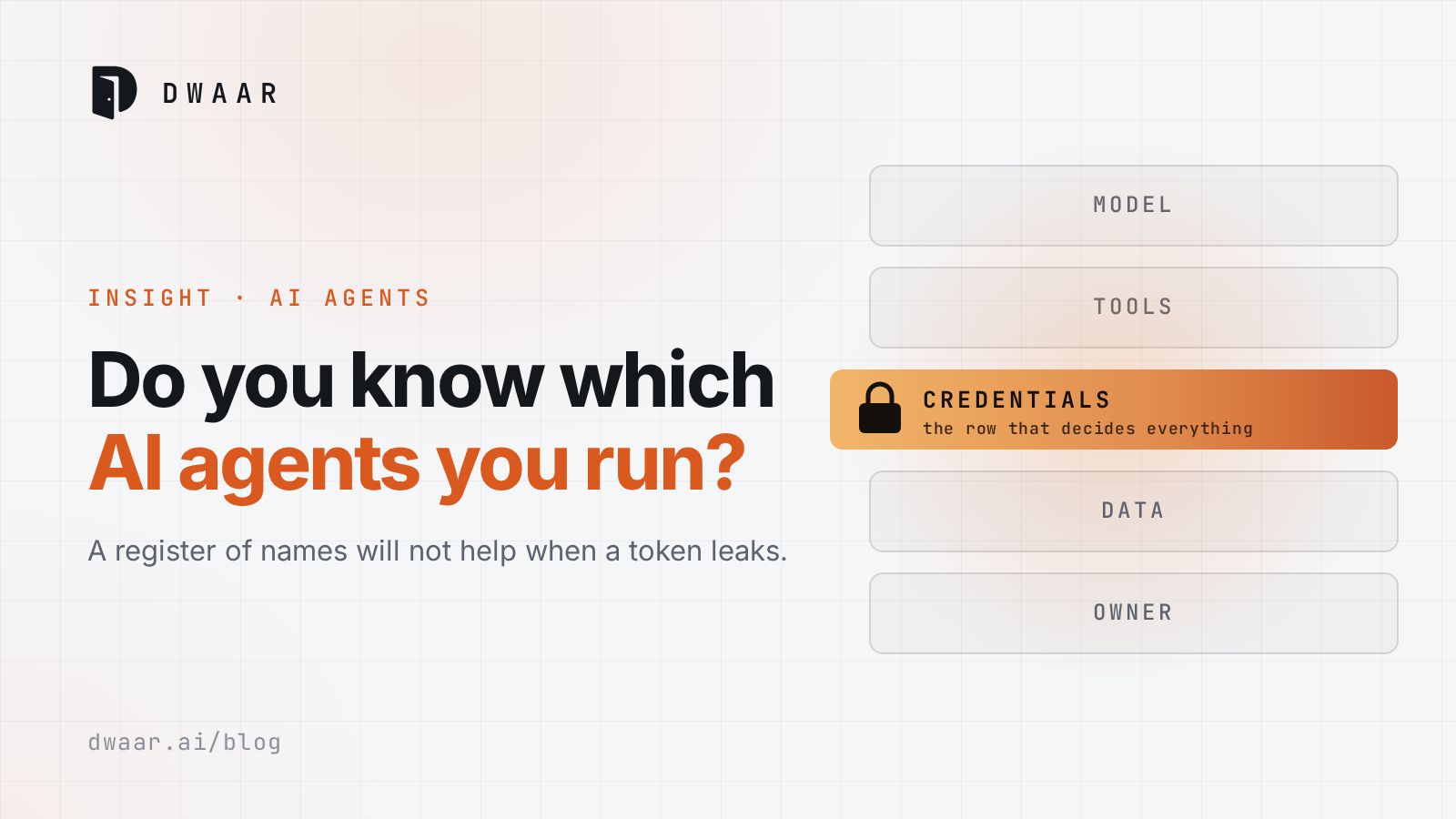
So take it apart. The model is the easy row. Record it and where it is hosted, but I consider it the least urgent, because a model name tells you little about what the agent can touch.
The tools tell you that. Where those tools are MCP servers, the transport matters, because it shapes where the credentials live. In the 2025-06-18 revision of the MCP specification, "Authorization is OPTIONAL for MCP implementations." HTTP-based transports should follow the OAuth 2.1-based flow, while STDIO implementations are told to "instead retrieve credentials from the environment." My reading for inventory: expect a STDIO server's token in its launch environment or client configuration rather than in an OAuth grant.
That makes credentials the row that decides everything. The same specification warns that a stolen token "can access protected resources with requests that appear legitimate to resource servers", so know beforehand what exists and who can kill it. IBM's report points the same way: 97% of breached organizations that experienced an AI-related security incident said they lacked proper AI access controls.
Data follows from credentials, since what an agent can reach is mostly what its tokens allow. Ownership closes the loop. The guidance in NIST SP 800-53 CM-8 lists "software owners" and "software version numbers" among the information necessary for effective accountability of system components, and enhancement CM-8(4), part of the high baseline, asks for a means of identifying the "individuals responsible and accountable for administering those components". I would hold an agent's tokens to the same standard.
| List | Where to find it | What to ask of it |
|---|---|---|
| Agent and owner | Repositories, SaaS admin settings, developer machines | Who answers for it, who approved it, and can they turn it off? |
| Models | Agent configuration | Which model, and hosted where? |
| Tools and MCP servers | Agent configuration, repositories | STDIO or remote HTTP? Who publishes it, and which version runs? |
| Credentials | Launch environments, client configuration, secret stores, identity provider grants | What scope, when was it last rotated, who can revoke it? |
| Data reached | The scopes of the credentials above | What can it read or change with these tokens? |
For remote MCP servers, also ask whether the server accepts only tokens issued for itself, as the specification requires.
Two incidents, and what they do not show
Neither of these is about an agent missing from a register. They support the credential half of my argument more than the rest.
In August 2025, Google Threat Intelligence Group reported that a threat actor it tracks as UNC6395 stole data from Salesforce instances using compromised OAuth tokens from the Salesloft Drift app. Google describes a third-party application with integrations and does not frame this as an AI agent incident. Google later found that tokens for the Drift Email integration with Google Workspace were compromised too. Its advice was to "treat any and all authentication tokens stored in or connected to the Drift platform as potentially compromised" and review all third-party integrations connected to a Drift instance. Following that requires a list of what is connected, and an agent holding tokens to your systems has the same shape.
In July 2025, AWS disclosed that an overly broad GitHub token in a build configuration let an attacker commit malicious code to the open source repository of the Amazon Q Developer extension for VS Code, affecting version 1.84.0. AWS says the code was "unsuccessful in executing due to a syntax error", and the fix was 1.85.0. Asking whether you were affected still meant knowing who had that version. So an AI coding tool's version is an inventory item, and if you build such tools, so is the token behind the build.
Where this stops applying
A list protects nothing. NIST says its GOVERN 1.6 actions are suggestions, and CM-8 asks for review at a frequency you define, so an inventory nobody reviews is a historical document. It gives you speed and accountability when something goes wrong. Access control is separate work.
A list also does not have to be complete on day one. NIST prefers inventorying all models or systems and warns that partial inventories "may not provide the value of a full inventory", but it accepts high-risk systems at minimum. If you cannot do it all at once, I would rank by what an agent holds: write access to production goes first, and a summarizer with no tokens can wait.
Discovery is the hard part. A self-reported register misses shadow AI, so you need identity provider, network and endpoint views alongside repositories, and each will still miss something.
Better standards could shrink this work. In February, NIST's NCCoE published a concept paper saying it was "interested in launching a project to demonstrate how identity standards and best practices can be applied" to software agents. I would not wait for that, because an identity standard will not tell you which agents someone started last week.
Fill in one row, twice
Pick the agent with the most access. Fill in its row from the table by reading its configuration, its launch environment and its token grants, without asking anyone. Then ask its owner to fill in the same row separately, and compare. Every disagreement is a mistake a register would have kept.
Finally, ask the owner: if every token this agent holds had to be revoked tonight, who does it, and what breaks? Write down the answer and the date. If nobody can answer, fix that before you start on agent number two.
Dwaar discovers what you ship from source control, registries and cloud accounts, scans it, and puts the results in one findings list with EPSS and KEV signals.
References
- NIST AI Resource Center, AI RMF Playbook: GOVERN (GOVERN 1.6), last revised August 2023 per the Playbook audit log
- NIST, SP 800-53 Release 5.2.0 catalog, CM-8, issued August 27, 2025 per NIST's publication page, with the control text also in NIST's OSCAL catalog and CM-8(4) in its high baseline profile
- IBM, IBM Report: 13% of Organizations Reported Breaches of AI Models or Applications, 97% of Which Reported Lacking Proper AI Access Controls, July 30, 2025
- IBM, 2025 Cost of a Data Breach Report: Navigating the AI rush without sidelining security, July 30, 2025
- Model Context Protocol, Authorization, specification revision 2025-06-18, June 18, 2025
- Google Cloud / Google Threat Intelligence Group, Widespread Data Theft Targets Salesforce Instances via Salesloft Drift, August 2025, updated August 28, 2025
- Amazon Web Services, Security bulletin AWS-2025-015: Amazon Q Developer for VS Code, July 23, 2025
- NIST, New concept paper on identity and authority of software agents, February 5, 2026