ingress-nginx CVE-2026-3288 and CVE-2026-4342: Config Injection as the Project Retires

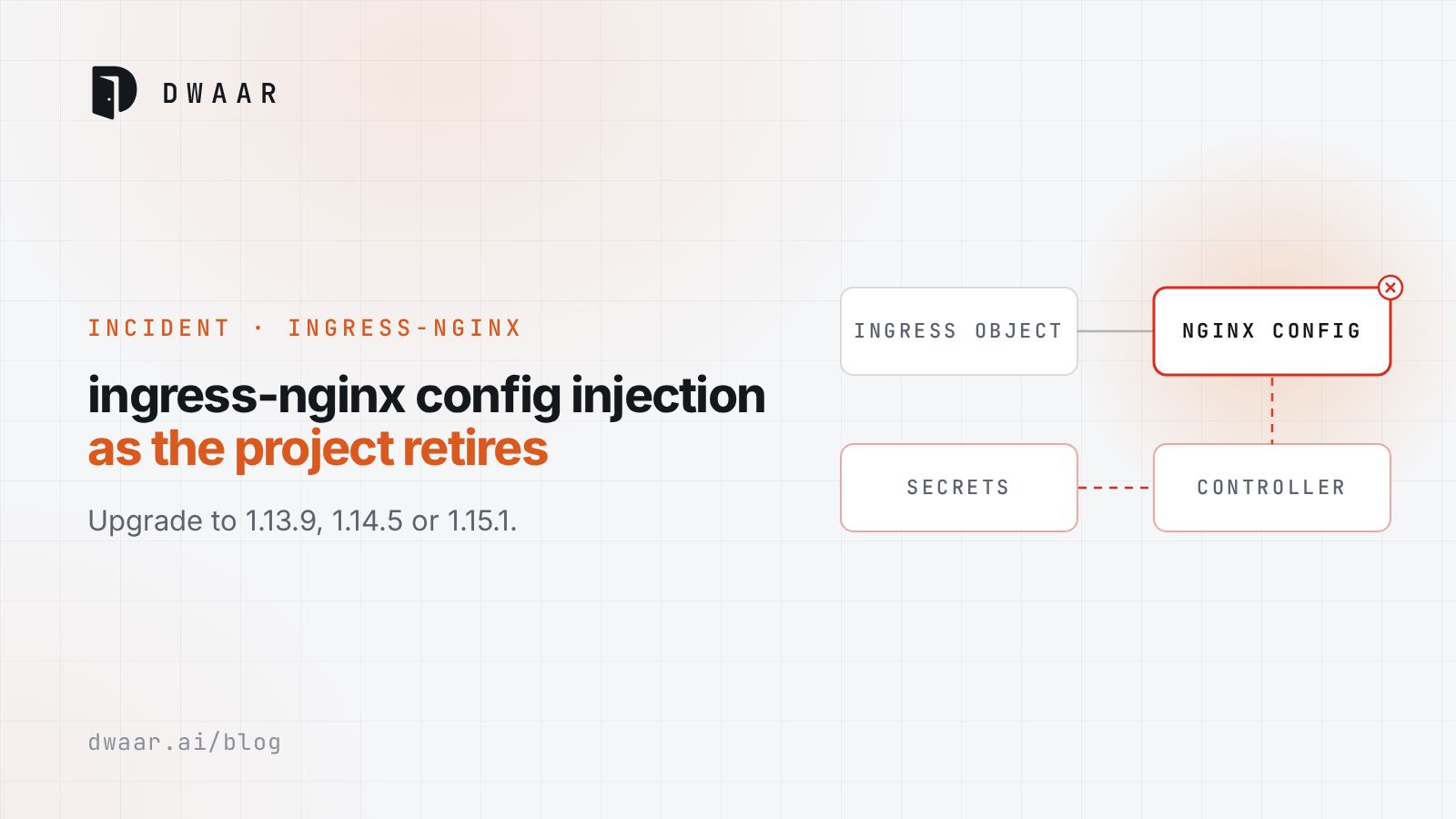
If you run ingress-nginx, anyone who can create or modify an Ingress object may be able to read every Secret in the cluster. Two advisories, ten days apart, describe the injection behind that risk, and they arrive in the month Kubernetes said maintenance would stop. The upgrade is the easy part. The harder question is where else this controller runs, and who owns getting it out.
| CVE-2026-3288 | CVE-2026-4342 | |
|---|---|---|
| Affected | Below 1.13.8, 1.14.4, 1.15.0 | Below 1.13.9, 1.14.5, 1.15.1 |
| Fixed in | 1.13.8, 1.14.4, 1.15.0 | 1.13.9, 1.14.5, 1.15.1 |
| Severity | HIGH, 8.8 (CVSS 3.1), scored by the Kubernetes Security Response Committee | HIGH, 8.8 (CVSS 3.1), scored by the Kubernetes Security Response Committee |
| Exploited as of 2026-03-20 | None reported, not in CISA KEV | None reported, not in CISA KEV |
| Disclosed | 2026-03-09 | 2026-03-19 |
"None reported" is an absence of reports, not proof: the advisories only ask anyone who finds evidence to tell them. The severity label has one disagreement: the CVE-2026-4342 issue calls the same 8.8 "Medium", while its advisory says HIGH. I use the advisory's rating.
How an Ingress object becomes code execution
The controller renders nginx configuration from Ingress objects and holds read access to Secrets. Any Ingress field that reaches that file unsafely turns a routing request into a config edit made by a far more privileged process.
CVE-2026-3288. The advisory says the nginx.ingress.kubernetes.io/rewrite-target annotation "can be used to inject configuration into nginx", and the CNA record tags it CWE-20 (improper input validation). Kubernetes issue #137560, which the advisory points to for details, names the fix as PR #14667, "Template: Quote proxy_pass." It sanitizes the path where buildProxyPass writes it into the quoted regex of the generated rewrite directive, using a helper that escapes backslashes and double quotes. That directive is only emitted when a rewrite target is set, which matches the annotation the advisory names. The 1.14.4 release notes do not mention the CVE, but they list the same change as #14668.
CVE-2026-4342. The advisory says only that "a combination of Ingress annotations" injects configuration, without naming them, and its title calls the issue "comment-based". The code-level detail is in PR #14728, "Template: Remove path from comment.", which the CVE issue names as the fix, merged on 2026-03-19. One line of its change to nginx.tmpl:
-    ## start auth upstream {{ $server.Hostname }}{{ $location.Path }}
+    ## start auth upstream {{ $server.Hostname }}
The matching ## end auth upstream line gets the same edit, and the 1.13.9 release notes list the change as #14731. So the Ingress path was being written into a generated nginx comment around the auth upstream block.
That block does not render for every Ingress. From reading shouldApplyAuthUpstream and the template condition visible in that diff, not from the advisory, it renders only for per-Ingress external auth with auth-keepalive above 0 and use-http2 turned off in the controller config. Neither is the default: auth-keepalive defaults to 0 and UseHTTP2 defaults to true. Do not treat that as a reason to skip the upgrade. The advisory lists affected versions with no configuration exception, and my reading of one code path does not prove it is the only one.
My reading of that diff, again not a statement from the advisory: a comment lasts only until the end of its line, so if a path can carry a newline, whatever follows stops being a comment and becomes configuration. That fits the title and the detection hint both advisories give: suspicious data in rules.http.paths.path. It also fits "a combination of Ingress annotations", since auth-url and auth-keepalive are both annotations.
For both, the impact is arbitrary code execution in the context of the controller and disclosure of the Secrets it can read. And "in the default installation, the controller can access all Secrets cluster-wide."
The vector for both is CVSS:3.1/AV:N/AC:L/PR:L/UI:N/S:U/C:H/I:H/A:H. It records that low privileges are enough. It does not tell you that those privileges buy every Secret in the cluster, which is why a score alone is a poor way to rank this.
What to check and do now
-
Find it, in every cluster. This is the check the advisories give. If ingress-nginx is not installed, that cluster is not affected.
kubectl get pods --all-namespaces --selector app.kubernetes.io/name=ingress-nginx -
Upgrade to 1.13.9, 1.14.5, 1.15.1 or later. Those cover both CVEs. The helm charts are 4.13.9, 4.14.5 and 4.15.1. If you patched on March 9, you are not finished: 1.13.8, 1.14.4 and 1.15.0 fix only CVE-2026-3288. Anything older than the 1.13 line has to move to a fixed line too.
-
If you cannot upgrade today, block what you can. Admission control that blocks the
rewrite-targetannotation mitigates CVE-2026-3288. The CVE-2026-4342 advisory publishes no workaround, so this is a stopgap, not a fix. -
Read your Ingress paths. Review
rules.http.paths.pathfor anything that does not look like a URL path. The advisories give no patterns and I will not invent any. If you find evidence of exploitation, report it tosecurity@kubernetes.ioand treat every Secret that controller could read as exposed. -
List who can write Ingress objects, including the service accounts your deploy pipelines use. Neither advisory states this precondition. On the CVE-2026-3288 issue, the author who signed the advisory describes it as a privilege escalation from "user with permission to create an ingress" to "probably cluster admin, depending on how the cluster is configured". The same appears to hold for CVE-2026-4342, since it is also driven by Ingress annotations. Either way, that list should be short.
The patch is the easy part
Kubernetes announced the retirement on 2025-11-11: best-effort maintenance until March 2026, and afterwards "no further releases, no bugfixes, and no updates to resolve any security vulnerabilities that may be discovered." The same post says the project has had only one or two people doing development work, on their own time, so I do not read these advisories as a failure of those people.
The sentence that should worry you is this one: "Existing deployments of Ingress NGINX will continue to function and installation artifacts will remain available." Nothing breaks. The controller keeps serving traffic and keeps its Secret access, and the first sign that it is unsupported will be a CVE with no fixed version.
I expect that CVE to come, though that is my opinion, not anything Kubernetes has said. The retirement post itself names the "snippets" annotations, which add arbitrary NGINX directives, as an example of a feature that became a serious security flaw. These two advisories show the same shape: Ingress input ending up as nginx configuration.
So this is two work items with different clocks. Upgrade this week. Then file the migration Kubernetes recommends, to Gateway API or another Ingress controller, as a security item with an owner and a date. An end of life date is a finding: it decides whether future CVEs can be fixed at all.
None of that works if you do not know where the controller runs. A scanner reports on what it is pointed at, which is part of why scanning alone is not a program. Discovering what you ship from source control, registries and cloud accounts, scanning it and putting the results in one findings list, with EPSS and KEV signals beside them, is the problem Dwaar works on.
Today, run the command above against every cluster you can reach and write down, for each: the controller version, whether it still has the default cluster-wide Secret access, who can write Ingress objects, and who owns the migration. Any cluster with no answer to that last one is your next job.
References
- CVE-2026-3288: ingress-nginx rewrite-target nginx configuration injection. Kubernetes Security Response Committee, 2026-03-09.
- CVE-2026-4342: ingress-nginx comment-based nginx configuration injection. Kubernetes Security Response Committee, 2026-03-19.
- CVE-2026-3288 issue #137560. kubernetes/kubernetes (GitHub), 2026-03-09, with the fix PR comment of 2026-03-09 and the privilege escalation comment of 2026-03-11.
- CVE-2026-4342 issue #137893. kubernetes/kubernetes (GitHub), 2026-03-19.
- Template: Quote
proxy_pass. (#14667). kubernetes/ingress-nginx (GitHub), 2026-03-09. - Template: Remove path from comment. (#14728). kubernetes/ingress-nginx (GitHub), 2026-03-19.
- template.go at controller-v1.14.4, with config.go and annotations.md at the same tag. kubernetes/ingress-nginx (GitHub), 2026-03-09.
- controller-v1.13.9 release notes. kubernetes/ingress-nginx (GitHub), 2026-03-19.
- controller-v1.14.4 release notes. kubernetes/ingress-nginx (GitHub), 2026-03-09.
- ingress-nginx releases feed. kubernetes/ingress-nginx (GitHub), entries dated 2026-03-09 and 2026-03-19.
- CVE-2026-3288 record. NVD, CNA data from Kubernetes, published 2026-03-09. Its change history shows CWE-20 added on first receipt that day.
- Ingress NGINX Retirement: What You Need to Know. Kubernetes Blog, 2025-11-11.
- Known Exploited Vulnerabilities catalog, version 2026.03.20. CISA, from its kev-data mirror on GitHub, released 2026-03-20. No entry for either CVE.