MCP STDIO: When Command Execution Is the Design

If your product has a form, an API or a config file where someone can add an MCP server over stdio, that person is choosing a command for your host to run. Researchers published that argument on 2026-04-15, with a list of downstream tools where it became OS command execution. Nobody had to misread the spec to get there.
| Identifier | Affected | Fixed in | Severity (scored by) | Exploited as of 2026-04-17 | Disclosed |
|---|---|---|---|---|---|
| No CVE found for the protocol behaviour | stdio pattern in the official MCP SDKs | No protocol or SDK change reported | No score found | None reported | 2026-04-15 |
| CVE-2026-30624 | Agent Zero 0.9.8 | None listed in NVD | 8.6 High (CISA-ADP, shown in NVD) | None reported; not in CISA KEV | 2026-04-15 |
| GHSA-c9gw-hvqq-f33r | flowise and flowise-components up to and including 3.0.13 | 3.1.0 | 9.9 Critical (GitHub advisory) | None reported | 2026-04-15 |
SecurityWeek describes the researchers exploiting this in their own testing and mentions no in-the-wild exploitation. CISA-ADP's SSVC entry on the CVE record for CVE-2026-30624 lists exploitation as none, and I found no report of attacks as of 2026-04-17. Everything I attribute to the researchers here comes through SecurityWeek, The Register and Infosecurity Magazine, so read it as their account.
The transport is a process launch
The MCP specification is plain about this: "The client launches the MCP server as a subprocess." It also says "Clients SHOULD support stdio whenever possible." So a stdio server definition comes down to a command, its arguments and its environment, handed to a process spawn. This is an illustration of the shape, not taken from any product, with placeholders in angle brackets:
{
  "command": "<launcher>",
  "args": ["<server-package>"],
  "env": {}
}
The researchers' complaint is that nothing separates that configuration from execution. SecurityWeek relays the sharpest detail: "the command is executed regardless of whether the process starts successfully." The developer sees an error, and no warning about sanitization.
So any path that lets someone influence a definition, whether a UI form, a JSON config, a marketplace entry or a prompt-injected edit to a config file, ends in a command running with the privileges of the host process. Agent Zero is the direct case: its External MCP Servers config accepts "arbitrary command and args values" and executes them when applied.
Four ways to reach it
The Register groups the researchers' results into four families:
- Command injection through the UI. LangFlow, which the researchers disclosed on 2026-01-11, and GPT Researcher (CVE-2025-65720).
- Hardening bypass. Developers allowlist launchers such as python, npm and npx, and the researchers inject through the arguments. Upsonic (CVE-2026-30625) and Flowise fall here.
- Zero-click prompt injection in AI IDEs that rewrite MCP config. Windsurf (CVE-2026-30615) is the only one with a CVE for this. Google, Microsoft and Anthropic reportedly called the others known issues or not valid, because the user has to permit the file change.
- Malicious marketplaces. The researchers say they poisoned 9 of 11 MCP marketplaces with a proof of concept that only created an empty file.
Family two is the one I would study. The Flowise advisory shows a team doing what most of us would do: validateCommandInjection, validateArgsForLocalFileAccess, and an allowlist of node, npx, python, python3 and docker. It still fell to an allowlisted command plus execution arguments such as npx -c. An allowlist of interpreters is an allowlist of whatever those interpreters are told to run.
Who owns the fix
According to the researchers, Anthropic declined to change the protocol's architecture and called the behaviour "expected". The Register says that about a week after the researchers' initial report, Anthropic quietly updated its security policy to say STDIO adapters "should be used with caution", which the researchers say fixed nothing. Infosecurity Magazine, again through the researchers, has Anthropic calling the model a secure default and putting sanitization on developers. SecurityWeek quotes no direct Anthropic statement, and Anthropic did not respond to The Register. Keep that gap in mind when you read "by design" in a headline.
The scale figures are also the researchers' and they count different things: up to 200,000 vulnerable instances and 7,000+ publicly accessible servers, plus 150M+ downloads and 200+ open source projects. The Register says ten CVEs so far and Infosecurity says 10+. Downloads are not exposure, so I would not plan around any of these numbers.
They also propose protocol changes: deprecate unsanitized STDIO, add command sandboxing, add an explicit opt-in "dangerous mode", and verify marketplaces with a security manifest. None of the sources I read reports any of these as adopted as of 2026-04-17, and SecurityWeek relays the researchers' view that the underlying flaw remains. MCP's Security Best Practices already say clients SHOULD sandbox local server commands, but that is guidance rather than enforcement, so plan without it.
The boundary is yours
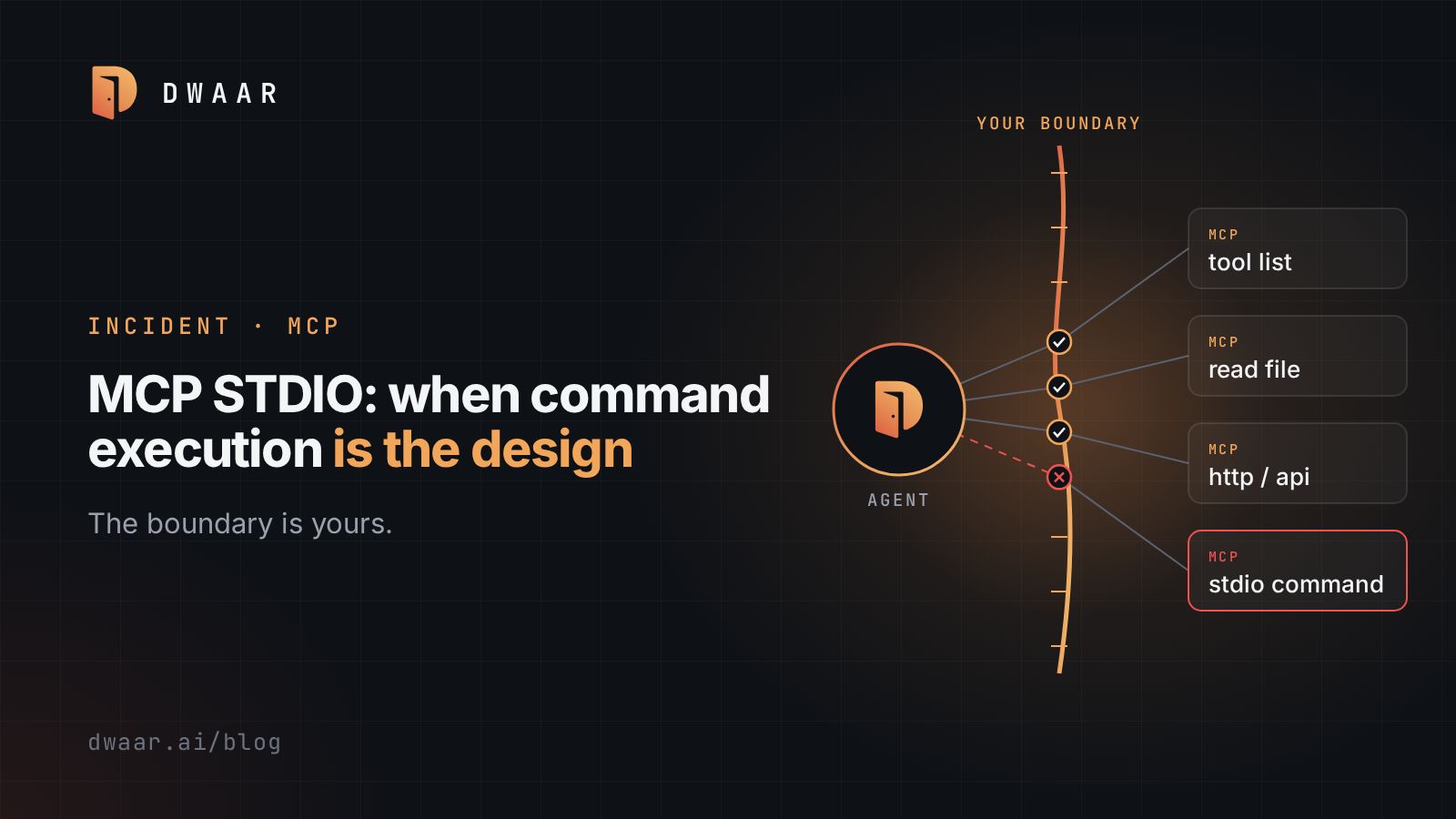
The stdio transport itself does not separate configuration from execution. MCP's Security Best Practices require consent only for one-click local server configuration and treat sandboxing as a SHOULD, so on every other path the boundary is yours to draw. My position on where it goes:
- A stdio server definition is code. Changing one is a deployment, with review and an owner. It does not belong in a settings form.
- Models and fetched content never write it. If an agent can edit the file its host spawns from, prompt injection is one step from a shell.
- Allow exact definitions, not launcher names. Pin the full command and arguments.
- Run the host with as little privilege as it can tolerate, because the spawned command inherits it.
Flowise needs an authenticated user and scores 9.9. Agent Zero's vector says no privileges required and it scores 8.6. Neither number knows who can reach the config screen in your deployment, which is the argument in CVSS Is Not Risk.
What to do now
- Flowise: upgrade flowise and flowise-components to 3.1.0 or later. The advisory lists no workaround.
- Agent Zero 0.9.8: NVD lists no fixed version. My advice is to keep the External MCP Servers config away from anyone you would not hand a shell.
- GPT Researcher and LangFlow: The Register reports no patch for the first and all versions affected, with no CVE, for the second. Apply the same advice.
- Upsonic and Windsurf: the sources I have give no fixed versions, so check with those vendors directly.
I found no official detection guidance, so this part is my own advice. Inventory your MCP configs and running MCP child processes. Flag stdio entries whose command is not a launcher you expect, or whose arguments carry -c or -e style flags.
Then pick one agent host you run, list every stdio entry in its config, and write down who or what can change each one. Any answer that includes an end user or a model is your first finding.
References
- The Register, MCP 'design flaw' puts 200k servers at risk: Researcher, 2026-04-16
- SecurityWeek, 'By Design' Flaw in MCP Could Enable Widespread AI Supply Chain Attacks, 2026-04-15
- Infosecurity Magazine, Systemic Flaw in MCP Protocol Could Expose 150 Million Downloads, 2026-04-16
- NVD, CVE-2026-30624, 2026-04-15
- GitHub Security Advisory (FlowiseAI), Authenticated RCE via MCP Adapters, 2026-04-15
- CVE.org, CVE-2026-30624, CISA-ADP entry updated 2026-04-15
- Model Context Protocol, Transports, specification 2025-06-18, 2025-06-18
- Model Context Protocol, Security Best Practices, specification 2025-11-25, 2025-11-25
- CISA, Known Exploited Vulnerabilities Catalog, living catalog, checked as of 2026-04-17