The EU Cyber Resilience Act Reporting Clock Starts This Week

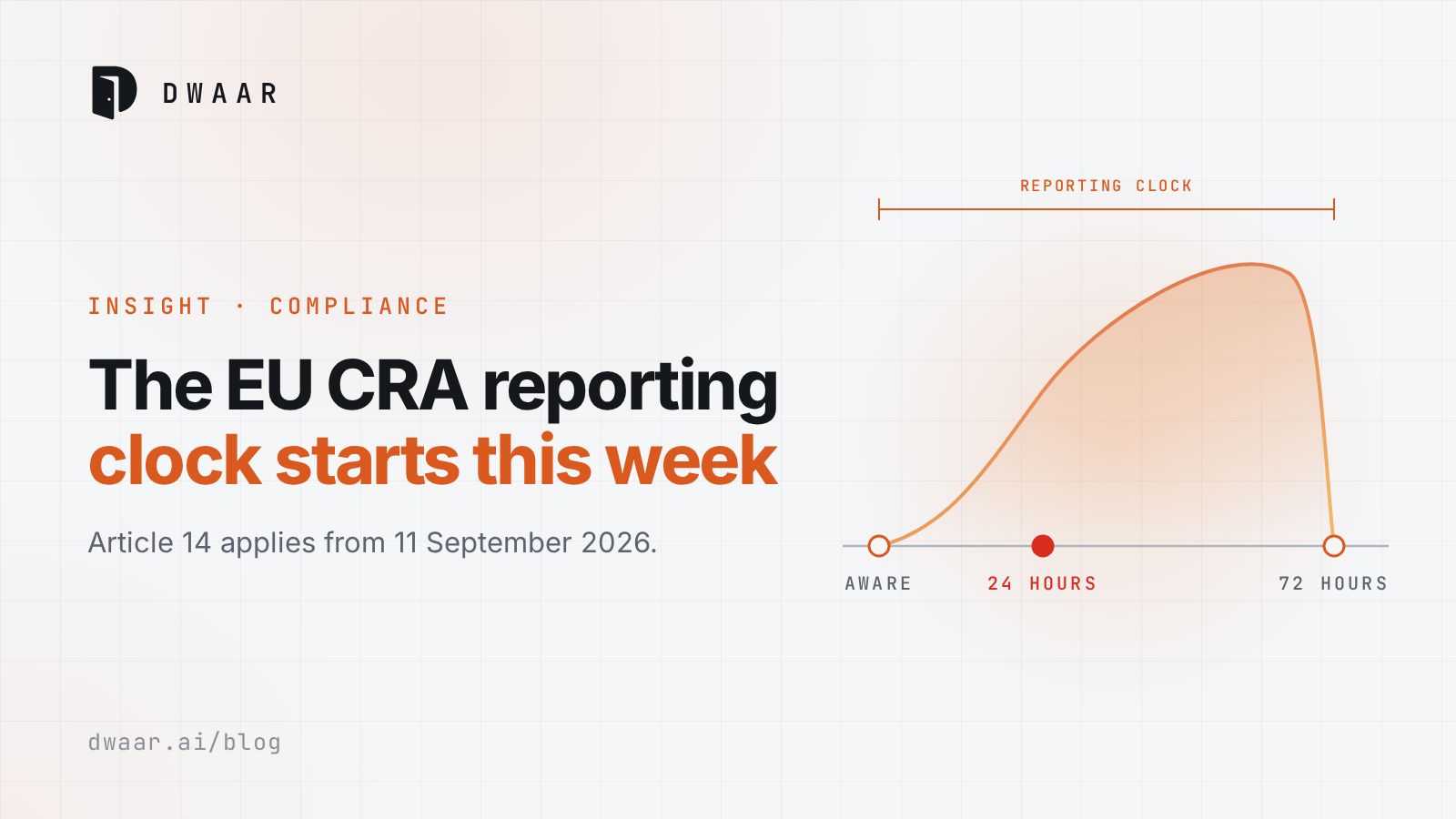
On Friday a new duty lands on manufacturers with a software or hardware product on the EU market. If a vulnerability in that product is being actively exploited, an early warning is due within 24 hours of becoming aware of it. Deciding who files that warning is the easy part. The harder part comes first: when a flaw in a component is reported as exploited, showing whether that component is in what you shipped, and whether the flaw can be or has been exploited there. That is where I would spend this week.
Article 71 of the Cyber Resilience Act applies Article 14 from 11 September 2026 and the main obligations from 11 December 2027 (Chapter IV, on notifying conformity assessment bodies, applied earlier, from 11 June 2026), so reporting arrives well before the design requirements, CE marking and SBOM duty. The Commission says it reaches "all products with digital elements that have been made available on the Union market", including those already out there.
This is an engineer's reading, not legal advice. Article numbers refer to the regulation on EUR-Lex. Paragraph numbers refer to the Commission guidance dated 27 July 2026, which says it is not binding and that an authoritative interpretation can only come from the Court of Justice (para 8).
What the clock asks
| Step, for an actively exploited vulnerability | Deadline | Runs from |
|---|---|---|
| Early warning | 24 hours | Becoming aware of it |
| Vulnerability notification | 72 hours | Becoming aware of it |
| Final report | 14 days | A corrective or mitigating measure being available |
Reports go simultaneously to the CSIRT designated as coordinator and to ENISA, through the single reporting platform of Article 16. Article 14(8) adds a duty to inform impacted users. Failing Articles 13 and 14 can draw fines of up to EUR 15 million or 2.5 percent of worldwide annual turnover, whichever is higher.
The trigger is narrower than it sounds. Article 3(42) requires "reliable evidence that a malicious actor has exploited it in a system without permission of the system owner". By that definition, a high severity score with no evidence of exploitation does not start this clock. Severe incidents, defined in Article 14(5), are a second track, so read the article itself for their final report.
The obvious plan, and where it breaks
The obvious response is to treat this as a filing problem: name an owner, write a runbook, rehearse the submission. Do all of that. It still breaks at the first step, because a runbook starts once someone says "this is in our product", and nothing in the runbook produces that sentence.
A runbook fits a researcher emailing you about your own code. It fits badly when the flaw sits in a library three layers down, and the Commission guidance draws a line there. A flaw of third-party origin has to be notified when your product contains it and it is actively exploited there. If it "cannot be exploited" in your product, for example "because the vulnerable code is not reachable", or "has not been exploited" in your product, it "is not subject to mandatory reporting" for you (para 218). You can still notify voluntarily under Article 15, and the same paragraph points to the vulnerability handling requirements and an upstream report to the component's maintainer.
That narrows the duty without shrinking the work. You cannot show that a flaw is unreachable or unexploited in a product until you know the component is there. So the inventory question comes before the legal one. That ordering is my inference, not the guidance's wording.
Log4j shows the order. CISA added CVE-2021-44228 to its Known Exploited Vulnerabilities catalog on 10 December 2021. Article 14 was years away, and on the Commission's reading a listing like that would not by itself make a flaw reportable by a manufacturer. As I read that episode, the difficulty was never understanding the bug. It was answering which of my products contain this component, and no later question can start until that one is answered.
It is tempting to read "becoming aware" as an exit: no looking, no clock. I would not build on that. Para 213 covers the case where a customer, an authority, a media organisation or another source brings a potential vulnerability to your attention. The manufacturer "should assess the suspicious event immediately", and is aware "when, after such an initial assessment, it has a reasonable degree of certainty" that a vulnerability contained in its product is being actively exploited. Para 214 adds that "the emphasis should be on prompt action to carry out the initial assessment". An assessment that stalls because nobody knows where the component is does not look like prompt action to me. Take the edge cases to your counsel. And from December 2027, Article 13(5) requires due diligence on third-party components, including open source.
What you have to be able to answer
You cannot secure what you cannot list, and you cannot run that initial assessment on it either. That is my inference, not the text. Article 14 does not mandate an SBOM. Article 3(39) defines one, and the requirement itself sits in Annex I and applies from December 2027. My position is to build it now anyway. It is only one input, and it has limits. The clock needs four answers:
| Question | Why the clock needs it | Where I would get it |
|---|---|---|
| Which products contain this component? | First filter: without it there is nothing to assess, but containing the component does not by itself trigger reporting | SBOMs per release, plus repositories and registries |
| Which versions are on the market? | Reporting reaches products already available | Release and support records |
| Who runs them? | Article 14(8) points at impacted users | Customer and update records |
| Has it been exploited in your product? | The Commission's non-binding guidance (para 218) reads the duty as covering exploitation in your product, so KEV alone does not settle it | Reachability analysis, your logs, reports from customers and third parties |
KEV is the cheap starting signal. Its feed holds roughly 1,700 entries dated up to this week, and intersecting it with your component records is mechanical. A match tells you CISA lists the flaw as exploited. It does not tell you the flaw was exploited in your product, so treat it as the start of the initial assessment, not the result.
There is a gap to keep in view. Article 3(42) speaks of exploitation "in a system" without saying whose, while Article 14(1) covers a vulnerability "contained in the product". The test of exploitation in your own product is the Commission's reading of those words, and only the Court of Justice can settle it. I would plan around para 218 and write down how you reached each conclusion.
Filing on time is not being secure
A filing proves a process ran. It does not prove the flaw got fixed, or fixed quickly. Nothing in the first table sets a date for the fix, and the final report timer starts only once a measure exists.
Set that against the summary of findings in Verizon's 2025 DBIR (p. 10). Vulnerability exploitation reached 20 percent of breaches as an initial access vector. Edge devices and VPNs went from 3 to 22 percent of the targets of that exploitation, and only about 54 percent of those edge device vulnerabilities were fully remediated throughout the year, at a median of 32 days. A manufacturer can meet every Article 14 deadline while its customers sit inside that window.
The same gap comes with the CE mark. The Commission summary says manufacturers can generally choose a self-assessment (module A), while important or critical categories may require a third party. So the mark does not by itself imply that anyone independent checked.
This is my argument, not a measurement. I have no source comparing CRA compliance with breach outcomes. Defenders of the regulation have a real point too: fast, mandatory, shared reporting is a security gain, since the coordinating CSIRT forwards notifications to CSIRTs in other Member States where the product is available. I accept that, but do not let "filed within 24 hours" become the number your security program reports upward.
Where this stops applying
The duty covers actively exploited vulnerabilities and severe incidents, not your backlog, so it is no vulnerability program. Per the summary, micro and small enterprises may not be fined for missing the 24-hour deadline, and open-source stewards are not fined at all.
Settle scope first. The guidance says software that "executes remotely and is merely accessed by the user" is not, on that basis alone, a product with digital elements (para 21), so a pure SaaS service with no distributed product may fall outside. Remote data processing solutions do count as part of a product, including for Article 14 reporting (para 178), so do not assume. Then put paras 213 and 218 next to your runbook: they set the awareness test and the third-party component rule your triage has to apply.
You can run the drill below with a spreadsheet.
Try it before Friday
Open the KEV feed and take the newest entry naming a component you believe you use, or Log4j if none fits. This is a rehearsal: on the guidance's reading, a KEV entry does not by itself start the legal clock. Start a 24-hour timer and answer: which shipped products contain it, whether it can be or has been exploited in them, which versions are on the EU market, which users you would tell, and who files. Count only what records show, not what someone remembers. "None" is valid only if you can show how you know. Every question still open when the timer ends is your CRA work list.
References
- Regulation (EU) 2024/2847, EUR-Lex, adopted 23 October 2024, Official Journal 20 November 2024
- Commission guidance on the application of Regulation (EU) 2024/2847 (Cyber Resilience Act), C(2026) 5252 final, annex, European Commission, 27 July 2026
- The Cyber Resilience Act, summary, European Commission, 3 December 2025
- Cyber Resilience Act, European Commission, updated 7 September 2026
- 2025 Data Breach Investigations Report, Verizon, 2025, summary of findings, p. 10
- Known Exploited Vulnerabilities catalog (JSON), CISA, CVE-2021-44228 added 10 December 2021