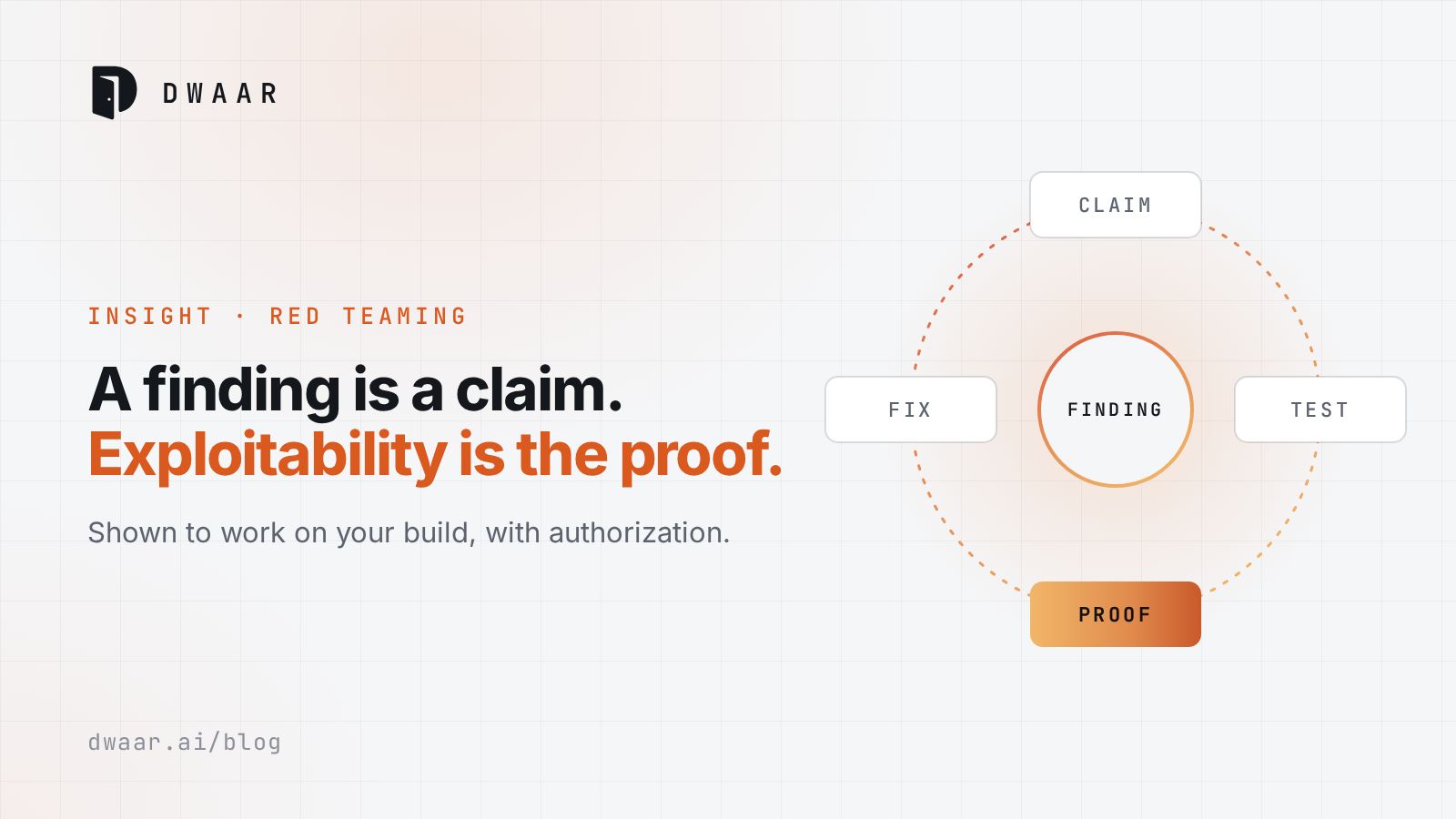
A Finding Is a Claim. Exploitability Is the Proof.

You file a ticket for a critical vulnerability in a library. The service owner replies that the vulnerable function is never called. You reply with the score. They reply with the sprint plan. The ticket stays open, and both of you still think you are right.
Nobody in that thread has evidence. The scanner made a claim: something matched, so this flaw may apply here. The owner made a counterclaim from memory of the code. The argument ends when someone tries the thing and shows what happened.
Better scoring does not settle it
The obvious fix is better prioritisation, and it is worth having. CVSS Is Not Risk covers how to use EPSS and KEV. But look at what each signal describes.
| Signal | What it tells you | What it leaves open |
|---|---|---|
| CVSS v4 Base score | Severity relative to other vulnerabilities | Whether anyone exploits it |
| CVSS v4 Exploit Maturity | Attacks reported, public proof-of-concept code only, or neither known | Whether it works on your build |
| SSVC Exploitation | None, Public PoC, or Active with reliable evidence of real attackers | Whether it works on your build |
| EPSS | Probability a published CVE is exploited in the wild in the next 30 days | Whether your deployment is exposed |
| CISA KEV | Reliable evidence of active exploitation in the wild, plus a clear remediation action; BOD 26-04 says the inclusion criteria "remain unchanged" | Whether your configuration is exposed |
| A demonstrated exploit | It worked on this build, from this starting position | Whether attackers are using it, and what else is wrong |
The standards already treat exploitation evidence as a variable that matters, but they apply it to the vulnerability out in the world. None has seen your build, configuration or data path. EPSS and KEV are also defined over CVEs, so a flaw in your own code with no CVE gets no signal from either.
My position is that the same logic should run locally. If evidence of exploitation moves a vulnerability up the global list, evidence that it works on your system should move it up yours.
Why the evidence is worth the effort
Two numbers look like they conflict. CISA's FAQ for BOD 22-01, a 2021 directive since superseded, cites a study of historical vulnerability data dating back to 2019 and says "less than 4% of all known vulnerabilities have been used by attackers in the wild." Verizon's 2026 DBIR executive summary says exploitation of vulnerabilities is now the most common initial access vector for breaches, at 31% in its reporting dataset, with credential abuse down to 13%.
One number counts vulnerabilities and the other counts breaches. Most known vulnerabilities have never been seen used by attackers, and the ones that are used are now the leading way in.
Capacity looks like the constraint to me. The same summary says only 26% of critical vulnerabilities, defined as those in CISA's KEV catalog, were fully remediated in 2025, down from 38% the previous year. The median time to full resolution went up to 43 days from 32, and in the median case organizations had 50% more critical vulnerabilities to patch than the year before. A finding with nothing behind it competes for what is left and loses.
"It is only theoretical" is also weaker than it sounds. Mandiant put average time to exploit at five days in 2023 with outliers removed, 47 days with them left in, and has "continued not to observe a correlation" between exploit availability and exploitation timing. No public proof of concept is not a safety argument.
Unproven claims have a cost too, and the receiver pays it. curl ended its bug bounty at the end of January 2026 to "remove the incentive for people to submit crap and non-well researched reports to us." The Register reported that none of the seven reports from the most recent week described a security vulnerability. A scanner backlog is not a bounty inbox, but the economics match: the claim is cheap and checking it is expensive.
What counts as proof
NIST's glossary sets the bar: penetration testing "often involves issuing real attacks on real systems and data," and most tests look for combinations of vulnerabilities that give more access than one alone. Proof is an active attempt, not an inference.
I hold a proof to four questions. On what did it work: the deployed build and configuration, not the main branch or a lab image sharing a version number. From where did it start: the position a real attacker would hold, stated plainly. What happened: an observed effect, and a chain counts. Can someone else rerun it: the owner should be able to check it, and repeat it after the fix.
A version match is not proof. Neither is a public proof of concept that ran in a lab. Those are reasons to run the test. Write "demonstrated" in the ticket and keep "exploited" for evidence of real attackers.
Proving it without causing the incident
"Real attacks on real systems and data" is exactly what makes this dangerous. Agree the limits first, in writing: which systems, which window, who is testing, when to stop. If a third party owns part of the path, their permission is a separate question.
Then keep the attempt non-destructive. Prove a read with a canary record you planted, not customer data. Prove execution with a harmless marker. Stop at the first evidence and leave nothing behind. Prefer a pre-production copy of the same build and configuration, and record how it differs from production, because each difference weakens the result.
In the US, TechCrunch reported in May 2022 that the Justice Department's revised CFAA charging policy "directs that good-faith security research should not be charged," for research done "in a manner designed to avoid any harm to individuals or the public." That is charging policy, not a statute, and it does not bind states. Your written authorization is what you rely on, so involve counsel before testing anything you do not clearly own.
Where this stops applying
Proof is asymmetric.
| Result | You can say | You cannot say |
|---|---|---|
| It worked | This build, from this position, is exploitable | Attackers are using it, or nothing else is wrong |
| It failed | This attempt failed | The flaw is unreachable |
| Not tried | Nothing | It is safe |
CISA's VEX justification guidance makes a related point about code said to be out of the execution path: paraphrasing, do not assume it, because an attacker may be able to divert the path. Treat "could not exploit" as a low confidence signal, never as a reason to close a finding on its own.
Nor should proof become a precondition for fixing things. If a vulnerability is in KEV and you run it, fix it.
It also does not scale. Exploitability depends on environment, chaining and attacker skill, so a proof on one finding generalises poorly to the next, and you will never test the whole backlog. Spend it on disputed findings and expensive fixes.
And it does not replace coverage. You can only test what you know exists, the argument of You Cannot Secure What You Cannot List. Knowing what exists is what Dwaar works on: discovering what you ship from source control, registries and cloud accounts, scanning it, and keeping one findings list with EPSS and KEV signals beside it.
Try it on one ticket
Pick your oldest open critical where the owner disputes the finding. Check KEV first; if it is listed, stop arguing and fix it. If not, get written approval, make one non-destructive attempt against a pre-production copy of the deployed build, and answer the four questions on the ticket. Mark it with one word: demonstrated, failed or untested. Then see whether that ticket moves faster than the ones around it.
References
- CVSS v4.0 Specification, FIRST, 2024-06-18
- SSVC Exploitation decision point, CERT/CC, version ssvc:E:1.1.0, undated page
- EPSS, FIRST, undated
- Known Exploited Vulnerabilities, CISA, undated
- BOD 22-01, CISA, 2021-11-03
- BOD 26-04: Prioritizing Security Updates Based on Risk, CISA, 2026-06-10
- 2026 DBIR Executive Summary, Verizon, 2026; the report was out by 2026-05-25, and this PDF is dated 2026-06-05
- Time-to-Exploit Trends 2023, Google Cloud / Mandiant, 2024-10-16
- Curl shutters bug bounty program, The Register, 2026-01-21
- Penetration testing glossary entry, NIST, 2008-09
- DOJ on good-faith hackers and the CFAA, TechCrunch, 2022-05-19
- VEX Status Justification, CISA, 2022-06