When an Attack Costs $25, Compliance Is Not a Security Program

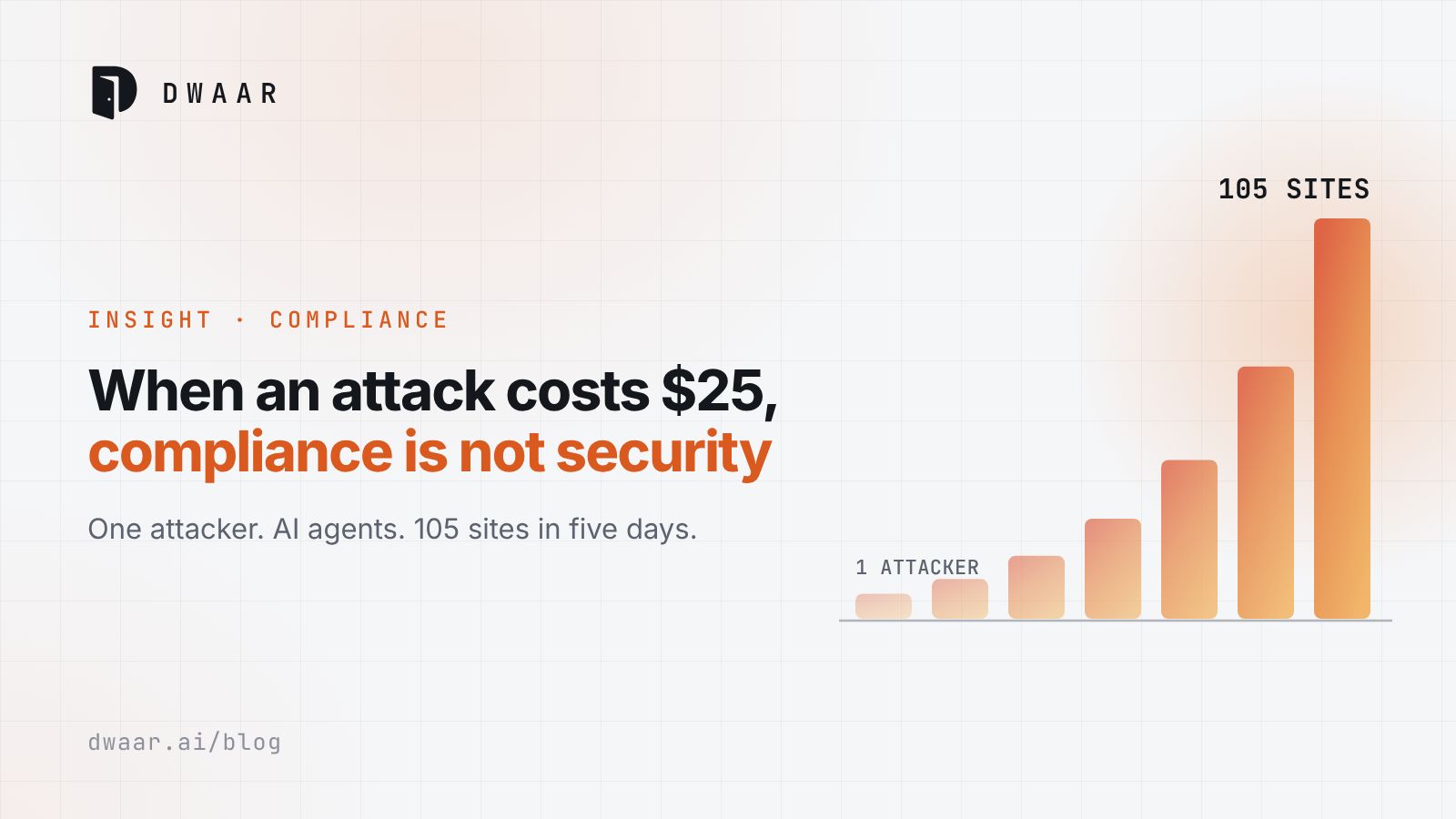
Most smaller companies run on an unspoken assumption: we are not interesting enough to attack, so we will do what the audit asks and spend the rest on the product. That assumption was always shaky. It rested on the attacker's cost, because a skilled team's time had to be spent somewhere worth it. AI agents have just cut that cost to the price of lunch.
| At a glance | |
|---|---|
| Campaign | One attacker, three AI harnesses, open-weight and public models, 105 e-commerce sites in five days, per Gambit Security |
| Compromised | At least 27 companies, usually within a day |
| Cost to the attacker | $25.46 on average per completed target |
| Lab test | Full domain control in eight minutes for about $12, per Silverfort |
| Price of initial access | Down from just over $1,400 to $429 on average, per Flashpoint |
| Reported | Dark Reading, 23 October 2026 |
What $25 bought
Over five days in September, a Chinese-speaking attacker pointed three AI harnesses at 105 e-commerce sites: the agentic system Hermes and two AI penetration testing frameworks, Strix and Cairn. At least 27 companies were compromised, usually within a day and often within hours. Agents stole at least 600,000 payment card records from two of them and installed card skimmers on the websites of five. The rest saw some degree of illicit access, and at least one was a Fortune 500 company.
The average bill was $25.46 per completed target.
"Work that would previously have required a coordinated team of skilled attackers can now be carried out by one person without much prior knowledge," Sa'ar Elias, co-founder and chief research officer at Gambit Security, told Dark Reading.
Eight minutes, $12
Silverfort ran the controlled version. An orchestrating agent using publicly available versions of Claude Opus started from initial access and reached complete domain control in eight minutes. The total cost was about $12.
"The barrier to entry is falling," said Colin Ferris, threat hunting and incident response lead at Silverfort. "What it takes is a basic foothold, not exotic skill."
The market agrees. Flashpoint reports that the average price of initial access sold in underground markets fell from just over $1,400 to $429. Fewer companies paid ransoms, 28% in the first half of 2026, yet ransomware activity still grew by 45%.
Why the cost curve lands on smaller companies
The data above says attacks got cheap. It does not break victims down by company size, so what follows is our reading of it, not a statistic.
When an attack took a skilled team days, attackers had to choose. Large targets justified the effort, and a small company was protected mostly by being not worth the time. At $25 a target, that filter is gone. An agent does not get bored of small websites, and 105 retailers in five days is what that looks like. Albert Ziegler, CISO at XBOW, put it plainly: every part of a company attached to the internet will be attacked, and the attacks in this campaign "work because the sites haven't been hardened enough."
Large enterprises felt this too, and the Fortune 500 victim proves it. But they have more to absorb the hit with: a security team, someone on call, budget for incident response. A smaller company often has a compliance checklist and an annual audit. When obscurity was doing the real work, that gap stayed hidden. Cheap attacks expose it.
A passed audit is not hardening
Compliance asks whether a control exists and whether you can show evidence for it on the day of the audit. Attackers ask whether it works today. Those questions overlap less than most teams think.
Look at what Silverfort says AI agents exploit: overprivileged accounts, reused credentials and unmanaged service accounts. None of these is exotic. All of them can survive an audit, because an access review done once a quarter is a passing control even when a service account has had domain admin rights since last year. "AI didn't create these weaknesses; it just finds them faster," Ferris said.
The encouraging part is in the same test. When Silverfort tightened controls, especially authentication and access, the same agent that took the domain in minutes hit 21 dead ends and gave up. The attacker's cost went up the moment the basics held. That is the lever a smaller company can actually pull.
Spend on what keeps the business running
Elias's advice is economic, and it scales down well. Defending against every attempt is unsustainable when each attempt costs the attacker so little. Instead, work out which business processes matter most and protect those from disruption. "Spending should increasingly be measured by how effectively it protects business operations," he said, "rather than simply how many threats or tools a security program can manage."
For a smaller team, that turns into a short list:
- Name your minimum viable business. Checkout, payments, customer data, the admin panel. If the agent in this campaign found yours, what would stop it?
- Fix the paths agents take first. Remove standing admin rights, retire reused and shared credentials, and give every service account an owner. Turn on strong authentication everywhere an attacker could start.
- Check continuously, not at audit time. An attacker running agents tests you every day. A quarterly review leaves the other 89 days unchecked. Use automated checks that confirm your controls still hold, and keep audit evidence as what those checks produce, not as a separate project.
- Treat every internet-facing asset as in scope. Ziegler's warning applies here: protecting a couple of crown jewel sites is not enough. The forgotten storefront or staging app is exactly what a $25 scan finds.
Remediation has to move at agentic speed, because discovery already does. And counting vulnerabilities will not tell you whether the account an agent would use next is locked down.
Try this next
Pick one service account in your most important system and answer three questions: who owns it, what can it reach, and when did anyone last check? If any answer is "we would have to look", you have found the eight minute path. Close that one before the next audit asks about it.
References
- AI Tools Are Generating Massive Attacks for Little Cost, Dark Reading, 23 October 2026
- Gambit Security's research on the retail campaign, Gambit Security
- Silverfort's research on the domain takeover test, Silverfort