Why Remediation Has to Move at Agentic Speed

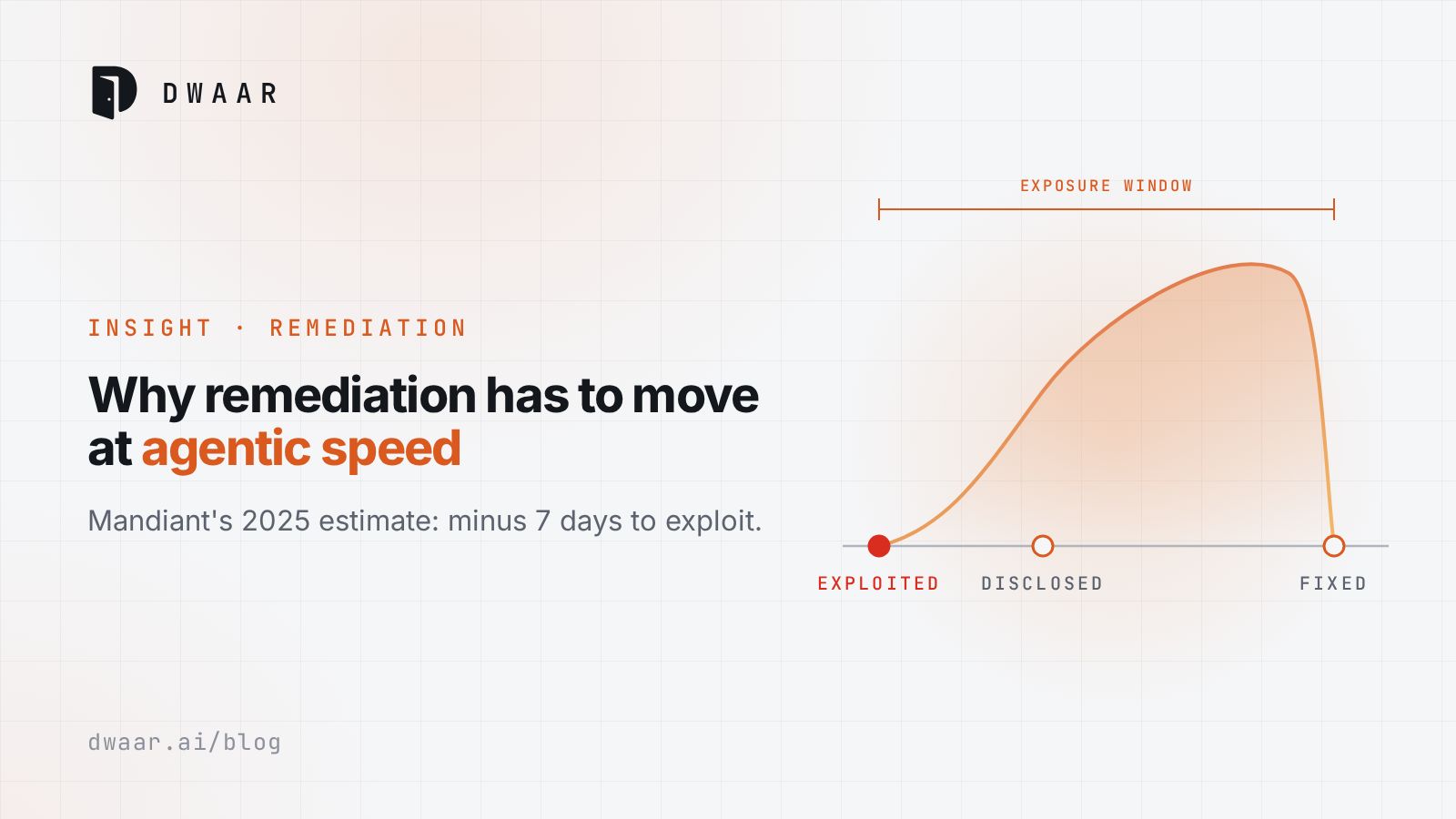
Walk a critical advisory through your own patch process and count the hand-offs. Someone reads it, someone works out whether you run the affected thing, someone finds the owning team, that team finds room in its plan, and the change waits for a review or a maintenance window. Every step has a good reason. Added together they make a timeline measured in weeks, and the number on the other side of the race has gone below zero.
The two clocks
Mandiant tracks time to exploit: the average time taken to exploit a vulnerability, before or after its patch is released. Its 2023 analysis and M-Trends 2026, published last week, give this series:
| Period | Average time to exploit |
|---|---|
| 2018 to 2019 | 63 days |
| 2020 to early 2021 | 44 days |
| 2021 to 2022 | 32 days |
| 2023 | 5 days, or 47 days with 15 outliers left in |
| 2025 | an estimated minus 7 days |
A negative number means exploitation routinely comes before the patch. Do not read the table as one clean line. The 2023 figure swings ninefold on outlier handling, the 2025 figure is an estimate, and Mandiant's 2023 analysis relies on the first reported exploitation, assuming the latest plausible date when that date is vague, so it calls its numbers conservative. The direction is still hard to argue with.
The defender's number is harder to pin down, and the most useful one I can cite is narrow. Verizon's 2025 DBIR, as reported by Infosecurity Magazine, found only 54% of edge-device vulnerabilities fully remediated, with a median of 32 days. That is one class of asset. It is also a class attackers want: Google's threat intelligence group tracked 75 exploited zero-days in 2024, 33 of them in enterprise technology, and 20 of those 33 in security and network products.
M-Trends 2026 also has exploits as the top initial infection vector for the sixth year running, at 32% of intrusions.
The time you get after a miss is shrinking too. The same report says that the median hand-off from initial access to a secondary threat group fell from over 8 hours in 2022 to 22 seconds in 2025.
I am not claiming AI caused any of this; these figures do not say that. "Agentic" in my title describes the response, not a measured result.
The obvious fix, and why it fails
The obvious fix is a tighter deadline. CISA's BOD 22-01 sets the public example: two weeks for newer KEV entries, six months for CVEs assigned before 2021, binding on US federal civilian agencies only.
Look at when that clock starts. A KEV entry requires "reliable evidence of exploitation in the wild", so the deadline begins after the attacks are already known. Langflow's CVE-2026-33017 shows the shape. It is unauthenticated remote code execution, rated 9.8 in NVD, where user-supplied flow code reached exec() without sandboxing. The project's advisory went out on March 16 and reached GitHub's Advisory Database on March 17, NVD published on March 20, and CISA listed it in KEV on March 25 with a due date of April 8. Counting from the project's advisory, that is 23 days to the deadline, with evidence of exploitation in hand by day nine.
A deadline is also not a mechanism. It tells people to go faster and removes none of the waiting. Give the same queue a tighter target and I expect more exceptions, not fewer days. And no deadline helps where there was nothing to apply yet. Mandiant says delaying patching raises the chance of a successful attack, and the same post points to segmentation and access control to limit the damage. Fast remediation is necessary. It is not sufficient.
Split the work by what a mistake costs
This split is my opinion: no source I can point to has tested it, or measured how much elapsed time agents remove from an enterprise patch process.
NIST SP 800-40r4 describes enterprise patch management as identifying, prioritizing, acquiring, installing and verifying. My bet is that most of the elapsed time in that sequence goes to people gathering context, not exercising judgment, and an agent can gather context at any hour. So give it everything where a wrong answer costs a review, and keep everything where a wrong answer costs an outage or a breach.
| NIST step | Agent does | Human keeps |
|---|---|---|
| Identify | Match the advisory to the repositories, images and versions you run | Checking the inventory itself is complete |
| Prioritize | Propose an order using KEV status, EPSS, exposure and ownership | Accepting a risk or deferring a fix |
| Acquire | Draft the upgrade or patch as a reviewable change | Any change touching authentication, cryptography or data handling |
| Install | Run the change through tests and staging | Approving the production deployment |
| Verify | Confirm the fixed version is running and rescan | Deciding what to do when verification fails |
The gate is cheaper than it sounds. Approving a prepared change with test results attached is a much smaller job than starting from an advisory.
Speed is not safety, which is why the production column stays human. A wrong draft wastes a reviewer's time. A wrong deployment is an outage you caused yourself. Hold the agent to that line: read access and the ability to open changes, no production credentials, no merge rights. Treat the advisories and packages it reads as untrusted input.
Do not spend this speed evenly either. EPSS estimates the probability that a vulnerability is exploited within 30 days of the prediction, and KEV lists confirmed exploitation. Use them to decide what jumps the queue, as I argued in CVSS Is Not Risk.
Where this stops applying
A true zero-day has no patch to draft, so the agent's useful work ends at telling you where you are exposed. After that the job is containment, and a person should own it.
Vendor appliances are the awkward case, because they are the kind of device behind the Verizon and Google numbers above. There is no repository to open a change against. An agent can find the affected boxes and prepare the change request, and that is about all.
Weak test coverage breaks the model entirely. An agent-drafted fix with nothing to check it against is a faster guess. On those systems, I would put the first effort into tests.
And if you run a handful of services with a team that can ship the same day, you already have the short path.
Try it on your last KEV fix
Pick the most recent KEV entry you had to fix and write down the timestamps: advisory published, someone knew you were affected, owner assigned, fix drafted, tests passed, change approved, running in production, verified. Mark each gap as waiting on information or waiting on a decision.
The information gaps are your candidates for automation. The decision gaps are where the human gate belongs. If you cannot fill in the first few timestamps because nobody knew what ran where, start there.
References
- How Low Can You Go? An Analysis of 2023 Time-to-Exploit Trends, Google Cloud / Mandiant, 2024-10-16
- M-Trends 2026, Google Cloud / Mandiant, 2026-03-24
- Hello 0-Days, My Old Friend: A 2024 Zero-Day Exploitation Analysis, Google Threat Intelligence Group, 2025-04-29
- Verizon's DBIR Reveals 34% Jump in Vulnerability Exploitation, Infosecurity Magazine, 2025-04-23
- BOD 22-01, CISA, 2021-11-03
- Known Exploited Vulnerabilities catalog, JSON feed, CISA, entry dated 2026-03-25
- SP 800-40 Rev. 4, NIST, April 2022
- Enhancing Vulnerability Prioritization: Data-Driven Exploit Predictions with Community-Driven Insights, Jacobs et al., arXiv, revised 2023-06-15
- CVE-2026-33017, NIST NVD, 2026-03-20
- GHSA-vwmf-pq79-vjvx, Langflow project on GitHub, 2026-03-16
- GHSA-vwmf-pq79-vjvx in the GitHub Advisory Database, GitHub, 2026-03-17