A Waiver Should Expire

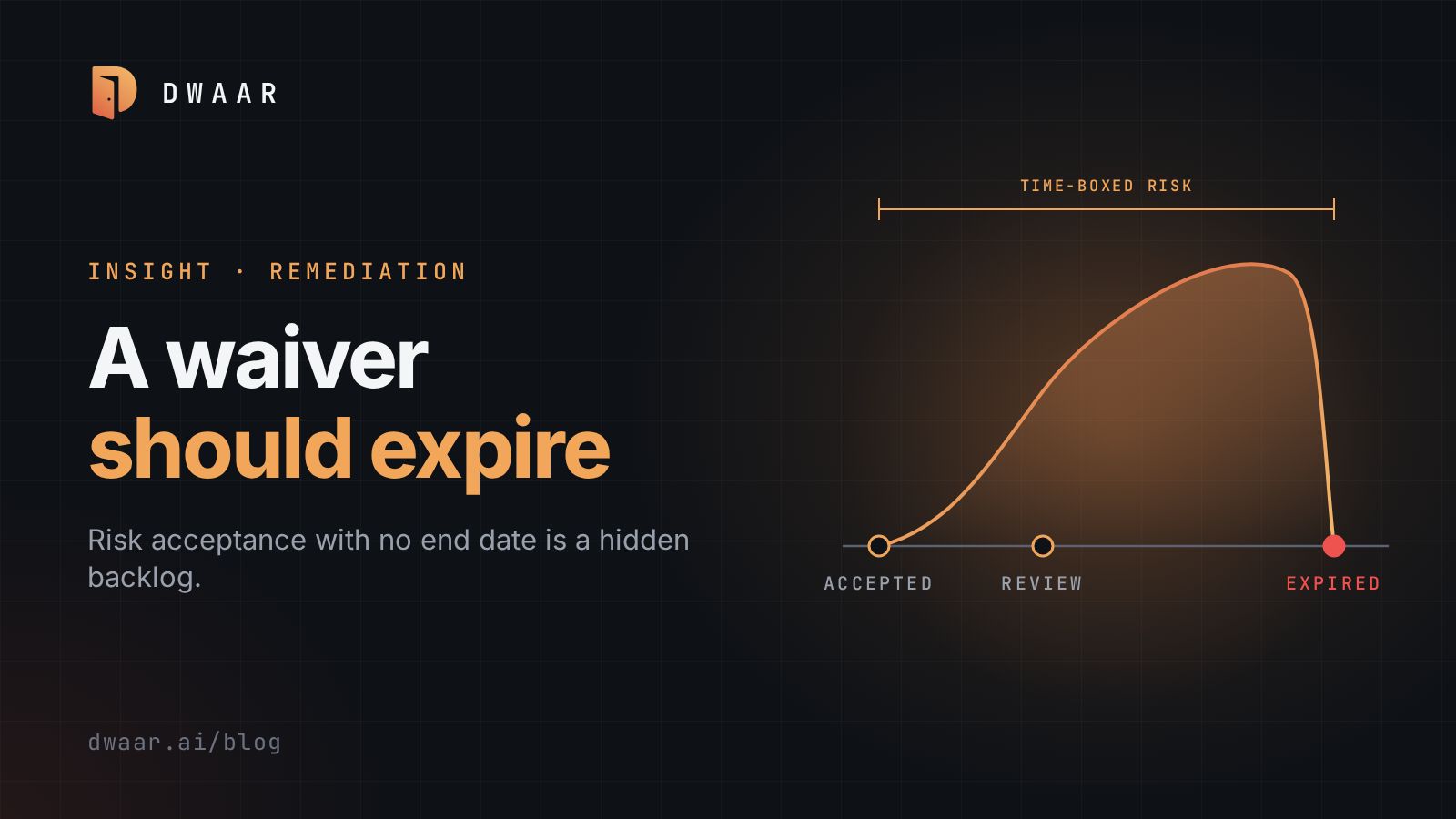
Filter your findings list to everything marked accepted and sort by age. Who approved the oldest one, what were they told, and is any of it still true? If the record cannot answer those questions, you do not have accepted risk. You have a backlog nobody is required to look at.
The route here is honest. A finding cannot be fixed this sprint, someone has a good reason, and the tracker offers a status called accepted with a comment box. The decision may have been right that day. The record keeps asserting it long after.
Why the status field fails
A status field records an outcome and removes the item from the view people work from. Nothing brings it back.
NIST's Risk Management Framework (RMF) shows what that status leaves out. SP 800-37 says plan of action entries "are not necessary when deficiencies are accepted by the authorizing official as residual risk." Fair enough, since a plan of action documents planned remediation and acceptance means there is none. NIST does not let the item vanish, though: accepted deficiencies "remain documented in the security and privacy assessment reports and are monitored for changes to the risk factors." A status with a comment box copies the exemption, so the item leaves the working list, and it skips the monitoring.
The RMF also gives the authorization itself a termination date that "indicates when the authorization expires." NIST does not apply that date to individual accepted findings, and the RMF is written for authorizing systems, not for waiving one CVE on one image. So I am borrowing its shape, not quoting a rule that binds your tracker.
The shape is right because the facts under a waiver move. CISA's BOD 26-04, issued on 10 June 2026 to replace BOD 22-01 and BOD 19-02, says so directly: "The timelines for each asset are dynamic as facts change." Its inputs are KEV status, public exposure, automatability and technical impact, and a new KEV listing shortens the timeline.
Two decisions hiding under one button
Before expiry can mean anything, separate noise from acceptance.
Suppression is a claim of fact: this does not apply here. A waiver is a decision: this applies, and we are living with it for now. CISA's VEX status justifications show the first kind done properly. A not affected status can carry a machine-readable reason in an optional field, and the document lists five, such as Component_not_present or Vulnerable_code_not_in_execute_path. Even then, CISA says the consumer "may choose to accept it or not" and that these statuses are "not intended to be a discussion-ending declaration." A suppression is a claim like any finding, and it can be wrong.
| Suppression | Waiver | |
|---|---|---|
| Who makes the call | An engineer who can show the evidence | Someone accountable for the risk |
| What backs it | A fact, such as the component being absent | A rationale and any control relied on |
| What ends it | The code or the reachability changes | A date passes or a named condition changes |
A single status for both does damage each way. Waivers get buried in test fixture noise, and real exposures can be filed as false positives because that path asks for no approver.
The border case is CISA's fifth justification, Inline_mitigations_already_exist. My position: if the reason depends on a control someone has to keep running, it is a waiver. Give it an owner and a date.
What the record has to hold
Who, why, until when, and under what condition. An illustration, not a schema from any standard or product:
# Illustration only.
finding: CVE-YYYY-NNNNN
scope: one image in one environment
accepted_by: a named person with authority over this risk
rationale: why it is not being fixed now
relies_on: the control in place, and how we know it is running
expires: YYYY-MM-DD
reopen_when:
  - the CVE is added to KEV
  - the asset becomes publicly exposed
  - a public exploit appears
  - a fix ships for the version we run
  - the control above changes or stops
For the who, the RMF is blunt: "the authorizing official is the only person who can accept risk." Keep the principle: one named person with authority over the risk, not a team alias, and not the engineer who wants the ticket closed.
For the why, SP 800-53 RA-7 lists "accepting risk with appropriate justification or rationale" as one response among several. "Low priority" is not a justification. Keep the scope narrow too: BOD 26-04 sets timelines per asset, and a waiver for a CVE everywhere is a policy nobody reviewed.
A date catches what you failed to predict. Conditions catch what you did predict. A waiver with only a date sits unchanged through a KEV listing, and one with only conditions lasts forever if the conditions are wrong. BOD 26-04's inputs are a good start for the list, and CVSS Is Not Risk covers why KEV belongs on it.
Expiry has to be loud
A date alone is not a control. When it passes, I want the finding back in the open list at its real severity, not a reminder email someone can archive.
The House Oversight majority staff report on Equifax shows what a silent lapse looks like. The report does not describe a waiver, but "the device used to monitor ACIS network traffic had been inactive for 19 months due to an expired security certificate", and it stayed that way until Equifax updated the certificate on 29 July 2017. An internal tracker entry dated 20 January 2017 had already recorded the wider problem: "SSLV devices are missing certificates, limiting visibility to web based attacks". Something expired, the wider problem was written down, and nothing forced a response. That is why relies_on is in the illustration: a waiver resting on a control is only as good as the last check of that control.
Where this position stops applying
Ongoing authorization is the first limit. NIST says organizations "may eliminate the authorization termination date" when a system operates under ongoing authorization, but that route swaps the date for a review frequency and continued, communicated acceptance by the official. Expiry becomes review, not permanence. If your conditions are evaluated continuously and someone reaffirms on a schedule, drop the date.
Deadlines you do not own are the second. A waiver in this post means internal acceptance. CISA's implementation guidance states that "CISA does not issue waivers or exceptions for actions required in cyber directives." If someone else owns the deadline, your waiver records your decision and moves nothing.
The third is the rubber stamp. Expiring waivers create work, and I have no study on how renewals behave, so this is my argument: renewal means answering the conditions again, not typing a new date. If nobody can answer, the finding goes back to open.
Try this on your own list
Export every finding marked accepted, ignored or false positive, and take the oldest ten. Sort them into the two columns of the table above. For each waiver, check two things today: is the CVE in the KEV catalog now, and is the asset publicly exposed now? CISA's test works as written: accessible to unauthenticated or untrusted entities via public networks. Unless that was already true when the waiver was signed, a yes means the decision rests on old facts, so reopen it. Everything else gets one named owner and one date this week.
References
- NIST, SP 800-37 Rev. 2, Risk Management Framework, December 2018
- NIST, SP 800-53 Rev. 5, RA-7 and CA-5, September 2020, includes updates as of 10 December 2020
- CISA, Vulnerability Exploitability eXchange (VEX): Status Justifications, June 2022
- CISA, BOD 26-04: Prioritizing Security Updates Based on Risk, 10 June 2026
- CISA, BOD 26-04 Implementation Guidance, updated 25 August 2026
- US House Oversight Committee majority staff, The Equifax Data Breach, December 2018